02 / 10
Chapter 2: Three Dozen Roses
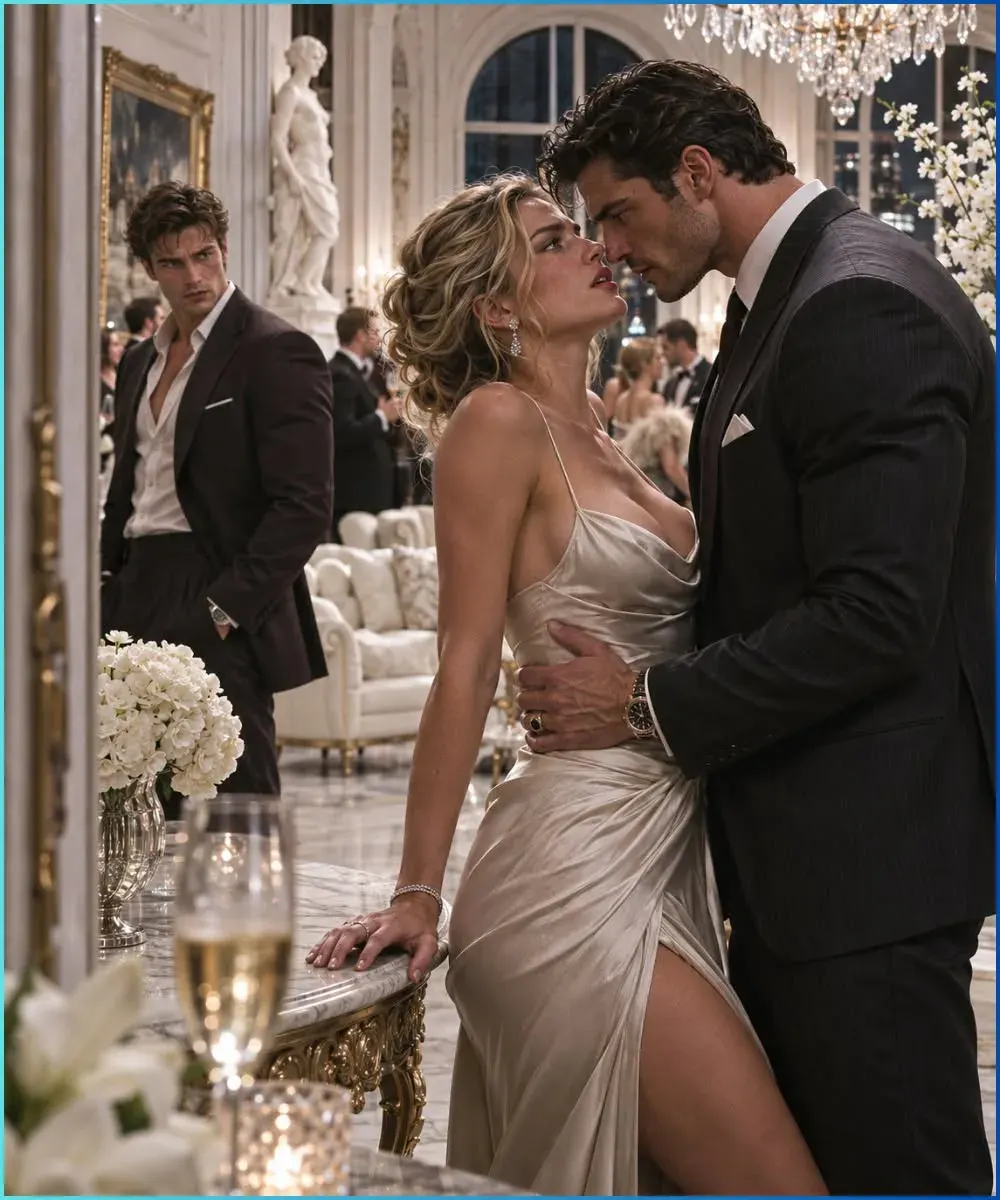
For two long seconds, Marcus didn't move.
He didn't look at his brother. He kept his eyes on me, his hand resting at my waist as lightly as if it had always belonged there, while the guests nearest us went quiet one cluster at a time.
Then he stepped back, unhurried, and straightened his white pocket square as though he had simply finished a conversation.
"Relax, Miles," he said without turning around. "I was admiring the arrangements."
"Sure you were," Miles said tightly, crossing the marble floor to stand beside me.
Marcus finally looked at him, and something passed between the brothers that I didn't understand—something old and heavy, older than me and older than that night. Then he turned back to me and inclined his head.
"Drive safely, Madison," he said, and walked away through the crowd without looking back.
Miles walked me out to my van in silence. The night air smelled like cut grass and lake water, and the valet had left my engine running, headlights glowing across the gravel.
"I'm sorry about him," Miles said, rubbing the back of his neck. "My brother doesn't ask for things. He just waits until they're already his."
"I'm not a thing," I said.
"I know that," he said, and his smile came back, a little crooked. "I'm just not sure he does."
He kissed my cheek again, carefully this time, and promised to call. I drove all the way back to the city with the windows cracked and the radio off, still wearing Victoria's gown and her diamonds, trying to decide whether I was furious or frightened.
Somewhere on the Kennedy Expressway, I admitted the truth to myself. Miles had made me laugh all evening, but Marcus had stolen my breath in less than a minute, and I could still feel exactly where his hand had rested.
I didn't sleep much that night. Every time I closed my eyes, I saw the marble table, the candlelight, and a pair of dark eyes that looked at me as though they had already decided something nobody had bothered to tell me.
At nine the next morning, a delivery driver carried three dozen blood-red roses through the door of Petals & Promises in a heavy crystal vase. Jenny actually shrieked.
They were perfect—long-stemmed, deep crimson, not a single bruised petal—the kind of roses I could only afford to sell, never to keep. Tucked among them was a cream envelope sealed with dark red wax.
Inside, the card read: Roses don't apologize for their thorns, and neither should you. Beneath that were two letters in bold black ink—M.T.
"Oh my God," Jenny squealed, reading over my shoulder. "Miles sent you roses?"
I stared at the initials. M.T. could only mean one man, I told myself, because only one Thornton brother had asked me to dinner.
So I texted Miles a photo of the roses and a thank-you. His answer came back within a minute—a winking face and four words: Glad you liked them.
I should have felt happy. Instead, I felt oddly flat, and I spent the next hour pretending not to notice.
At noon, a mail carrier asked me to sign for a certified letter. It came from a company called Halcyon Holdings, which had bought my building the week before, and it informed me in polite legal language that my lease would not be renewed.
I had sixty days to get out.
I sat down hard on an overturned bucket in the back room. Five years of my life, my grandmother's money, every credit card I owned—and a stranger had ended it all with one sheet of paper.
I looked around at the cracked tile floor I had grouted myself, the chalkboard of seasonal stems Jenny redrew every Monday, and the dented brass bell my grandmother had once hung over her own kitchen door in Joliet. Every inch of that room had my fingerprints on it.
Jenny found me there and didn't say a word. She just sat down on the bucket beside mine and held my hand until the shop bell rang.
By six o'clock, I had cried, called two lawyers who never called back, and looked at four retail listings I couldn't afford. I was flipping the sign to Closed when the bell over the door chimed one last time.
Marcus Thornton walked in out of the evening rain, shaking water from his dark hair, a black overcoat over his charcoal suit. He glanced at the roses on my counter, then at me, and something like amusement touched his mouth.
"You thanked my brother," he said, "for my roses."