01 / 10
Chapter 1: Table Seven
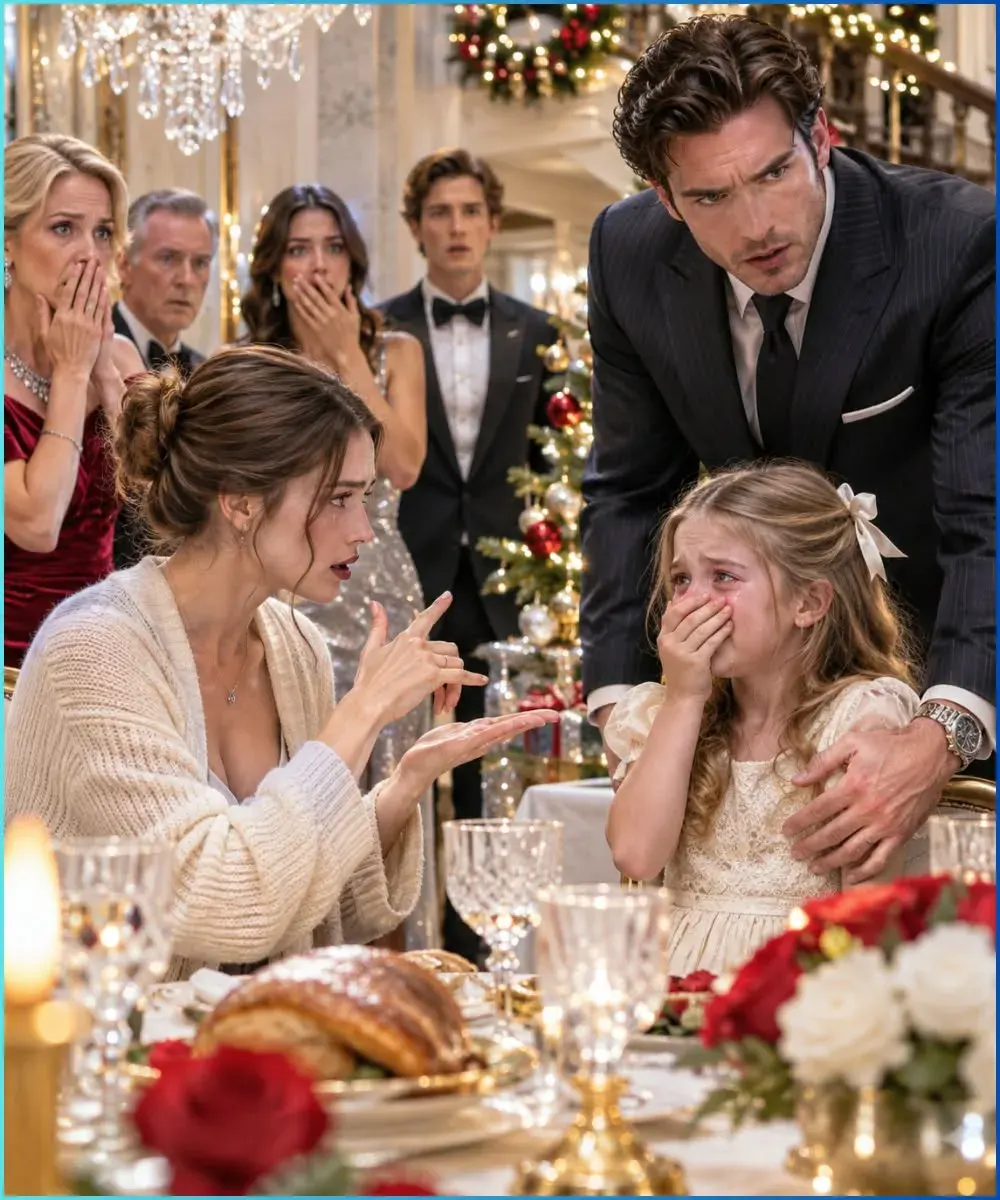
Twelve wealthy adults at Table Seven looked straight at a crying six-year-old in a cream lace dress that Christmas, and not one of them realized she had been begging for help with her hands for almost an hour. I was the only person in that glittering ballroom who could read what she was saying—and I was just the woman in the maroon uniform refilling the coffee.
My mornings started at five, scrubbing conference rooms in a Loop office tower, and three nights a week I carried trays at the Grand Whitmore Hotel for tips and overtime. Brianna Cole, thirty-four, single mother, two jobs—whatever it took to keep the heat on in our second-floor apartment above a taqueria in Pilsen.
That December, every extra shift had a name: the used laptop my fifteen-year-old son, Caleb, needed for school. He never once asked for it—he just kept typing his essays on his cracked phone at the kitchen table, squinting, and pretending that was fine.
My sneakers were worn nearly smooth at the heels, and my banquet uniform was a size too big because the hotel had run out of mediums. None of that mattered once the ballroom doors swung open.
The Calloway Advanced Systems Christmas dinner filled the Whitmore's grand ballroom with crystal chandeliers, white linen, candles in gold holders, and red and white roses on every table. A towering tree hung with red and gold ornaments stood beside the stage, and twinkling garlands wound up the grand staircase, where executives' wives posed for photos in diamonds.
At Table Seven sat Ethan Calloway himself, the billionaire founder of the company—late thirties, tall, with dark wavy hair, light stubble, a silver watch, and a navy pinstripe suit with a white pocket square that probably cost more than a year of my rent. Beside him sat a little girl in a cream lace dress with puffed sleeves, a cream satin bow tied in her long, wavy light-brown hair, clutching a faded brown teddy bear.
In the kitchen, the servers gossiped about them in low voices. Ethan Calloway's wife had died suddenly fourteen months earlier, and his daughter, Ellie, was deaf.
I noticed Ellie's hands before I noticed her tears. She kept moving them against the bear's worn fur in small, half-finished shapes, the way a child signs when she has stopped expecting anyone to answer.
My little brother, Marcus, was born deaf when I was four. Our parents loved him fiercely, but a doctor convinced them that sign language would keep him from ever learning to speak, so for years they drilled him on sounds and scolded him for using his hands, and I watched my bright, funny brother turn silent and furious.
At sixteen, I signed up for free ASL classes at a community center on the West Side. Within a year, Marcus and I were holding entire conversations across the dinner table that our parents couldn't follow, and the boy who had stopped trying came roaring back to life.
So from my coffee station, I could read every piece Ellie was making. A small fist with the thumb tucked between two fingers, shaken side to side, meant bathroom, and a thumbs-up fist resting on a flat palm, lifted together, meant help.
Then, once, she touched the thumb of an open hand to her chin. Mom.
She tugged her father's sleeve. Ethan glanced down, gave her a distracted smile, squeezed her hand, said something too fast for her to catch, and turned straight back to the silver-haired investor across the table, who was tapping a leather folder and talking about January.
A woman in emeralds leaned down and shouted into Ellie's face, stretching every word like taffy, as if volume could fix ears that simply worked differently. Ellie shook her head and buried her face in the bear's fur.
I set down my coffee pot, and Gwen Hatcher, the banquet captain, caught my elbow before I took a step. "Don't even think about it, Cole," she hissed. "Guests are not your business, and I've got three tables waiting on decaf."
I needed that shift more than I needed my pride. So I poured decaf and watched Ellie try two more times, and two more times, nobody at Table Seven saw.
At nine-thirty, my shift ended. I changed in the staff locker room into my own clothes—a cream chunky knit cardigan over a plain white top and the thin gold necklace my grandmother left me—and twisted my brown hair into a messy bun, a few loose strands falling around my face.
The shortest route to the employee exit ran along the edge of the ballroom. When I reached Table Seven, the speeches had started, and Ellie was crying openly now, one small hand pressed over her mouth so hard that her knuckles had gone white.
Ethan was finally on his feet behind her chair, one hand on her shoulder, bending over her while the guests around them stared in uncomfortable silence. "Ellie, sweetheart, please," he said. "What's wrong?"
The panic in his brown eyes told me he truly didn't know. With her face turned down, Ellie couldn't see his lips, and even if she had, the words wouldn't have reached her.
The chair directly across the table from her was empty, because some executive had wandered off to the bar. Before I could talk myself out of it, I slid into that seat, leaned forward, and waved once, low and gentle, until her wet eyes found mine.
Then I signed and spoke at the same time, pointing to her and spelling out O-K with my eyebrows raised, the way a question looks in ASL. "Hey," I said, my voice catching and my hazel eyes blurring with tears. "Are you okay?"
Ellie's tears stopped for one stunned second. Her small hand slid down from her mouth, and then her hands flew so fast that the people around us leaned back, as if a bird had burst out of the centerpiece.
I read every word. And when she reached the last thing—the thing she said she had been trying to tell her father for fourteen months—I realized her father hadn't understood a single word of it.