01 / 10
Chapter 1: Two Squeezes
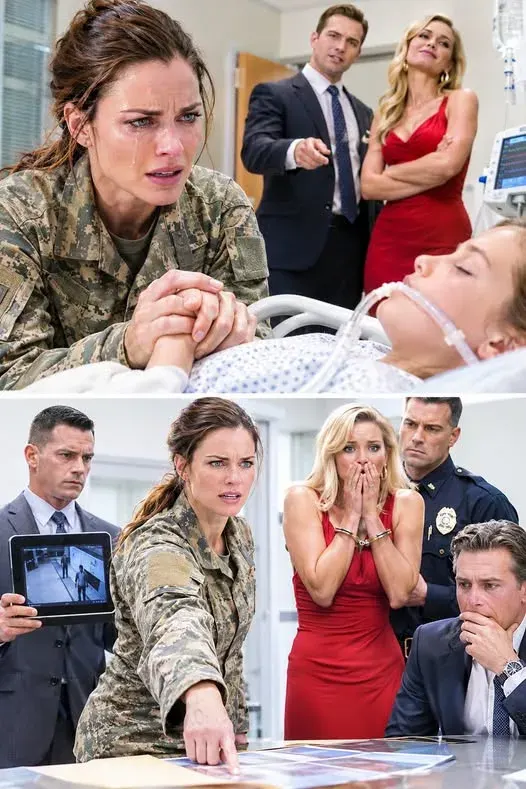
My twelve-year-old daughter had been unconscious for nine days when I discovered that her father was preparing to let her die. And the moment her small fingers squeezed mine twice, I realized someone had been lying about what happened to her.
My name is Catherine Hayes. I was thirty-nine years old, a major in the United States Army, and seventy-two hours earlier I had been sitting in a plywood operations center in eastern Poland reading intelligence reports when my commander handed me a red emergency message.
Your daughter has been injured. Critical condition. Contact family immediately.
It had taken me three days, four flights, two oceans and one shouting match with a transportation officer in Ramstein to reach Charlotte, North Carolina. I didn't change clothes. I didn't sleep. I walked into the intensive care unit at St. Catherine's Medical Center still wearing my camouflage uniform, my name tape dusty, my backpack hanging off one shoulder.
Outside Room 417, my ex-husband, Richard Collins, stood beside his girlfriend, Vanessa Blake.
Richard looked the way he always looked when something was hard. Smooth. Distant. Navy sweater, combed hair, eyes fixed on a spot somewhere past my left shoulder. Vanessa stood half a step behind him in a camel coat and pearl earrings, her blonde bob perfect, her arms folded.
"The doctors want a family meeting Friday," Richard said, barely looking at me. "It's time to let Emily go."
My entire body went cold.
"Let her go," I repeated. "She's twelve, Richard."
"And she's not coming back." He said it like a weather report. "Dr. Thornton says there's been no meaningful brain activity for days. The kindest thing is to stop dragging it out."
"Nine days," I said. "It's been nine days. People wake up after nine months."
"People," Vanessa said lightly, "who have mothers who visit."
A nurse at the station looked up. Two visitors waiting by the elevator turned their heads.
Vanessa looked my uniform up and down with a poisonous little smile. "It's funny, isn't it? You can serve your country, but you can't show up for your own kid. Richard's been here every single day. I've been here every day. Where were you?"
"In Poland," I said evenly. "Under orders. Trying to get here."
"Some mother you are," she said.
I had faced men who wanted me dead. I had sat across tables from people who lied for a living. I had never wanted to hit anyone as badly as I wanted to hit that woman in the hallway of a children's ICU.
I didn't. I refused to give Vanessa the satisfaction of seeing me break.
I walked past them both and pushed open the door to Room 417.
Emily lay motionless beneath a white blanket, surrounded by monitors. Her long chestnut hair had been carefully braided over one shoulder. A breathing tube was taped at the corner of her mouth, and a ventilator sighed beside her bed in a slow, steady rhythm. There was a fading yellow bruise along her left temple and another on her forearm, the shape of which I noticed without wanting to.
Nine days earlier, Richard had called my unit's family readiness office to report that Emily had fallen down the stairs at his house in Ballantyne.
A terrible accident. That was his explanation. Four sentences in an email, forwarded to me through two officers.
I sat beside her and took her hand. It was warm, and so small.
"Hey, sweetheart," I whispered. "Mommy's here. I came as fast as I could."
For several seconds, nothing happened. The ventilator breathed. The monitor beeped.
Then I felt it.
Two squeezes.
My heart almost stopped.
When Emily was six, she was terrified of thunderstorms. Our house in Fayetteville had a tin roof over the porch, and the rain sounded like gunfire. So we invented a secret code, just for the two of us, to use when she was too scared to talk.
One squeeze meant I love you.
Two meant I'm scared. Help me.
She hadn't used it in years. She'd told me at eleven that she was way too old for it.
I leaned closer, my lips almost touching her ear. "Emily, honey. Can you hear me? Squeeze once if you can hear me."
One faint squeeze.
Then two again. Harder. Urgent.
Then nothing.
My training kicked in before my emotions could. I looked at the monitor. Her heart rate had jumped from 78 to 104 while I spoke. I memorized the time: 4:17 p.m. Then I pressed the call button.
A nurse came in, a woman in her forties with tired kind eyes and a badge that read SARAH MITCHELL, RN.
"She responded to me," I said quietly. "She squeezed my hand on command. Twice."
Sarah's expression changed instantly. She checked Emily's pupils with a penlight, then looked at the monitor history. "Her heart rate spiked," she murmured. "That's important. I'll notify the neurologist."
She started toward the door, then stopped and glanced at the glass, where Richard and Vanessa stood watching. She lowered her voice.
"Mrs. Hayes, there's something you should know. Your ex-husband requested that you receive no medical updates while you were deployed. We were told not to call you."
My stomach tightened. "Who authorized that?"
"He said he had sole medical authority. He signed a form."
I reached into my backpack and pulled out a plastic sleeve I had carried through four airports: a certified copy of our custody agreement, signed by a Mecklenburg County judge three years earlier.
"We share joint legal custody," I said. "Paragraph eleven. Neither parent can make major medical decisions alone. That includes withdrawing life support."
Sarah read paragraph eleven twice. Then she quietly closed the door.
"I'm going to make a copy of this for the chart," she said. "And I'm going to tell the charge nurse that nothing happens Friday without both signatures."
Through the glass, I watched Richard's face change as he saw the paper in Sarah's hands. Vanessa leaned in and whispered something to him. His jaw tightened.
When Sarah left, I looked at my daughter's chart on the computer screen she'd left logged in for the copy. I'm not a doctor. But I read reports for a living, and I know what a pattern looks like.
Emily's sedation had been reduced on day four. Her notes on day five said "some purposeful movement, grimace to stimuli." Hopeful. Then, on day six, the sedation was increased again. Then again on day eight. Each order signed by the same name.
Dr. Mark Thornton, attending physician.
The same doctor who was telling Richard there was no brain activity.
Why would you heavily sedate a child you believed was already gone?
The door opened. A tall man in his mid-forties walked in wearing a white coat, silver at the temples, handsome in the polished way of a man who knew it. Dr. Mark Thornton.
"Mrs. Hayes," he said warmly, extending his hand. "I'm so sorry we're meeting under these circumstances."
I shook his hand. Emily's monitor jumped. 92. 101. 118.
Beneath my other palm, her fingers tightened. Two squeezes. Then two more. Then two more, frantic, over and over, as if she were trying to scream through her hand.
Dr. Thornton glanced at the monitor and frowned. "Agitation is common. Reflexive. I'll increase her sedation so she's comfortable."
"No," I said. "You won't."
He smiled patiently. "Mrs. Hayes, I understand this is—"
"Nothing in her treatment changes until I've seen every record and an independent neurologist has examined her. Joint custody. Paragraph eleven. Your nurse has a copy."
The smile stayed on his face. It didn't reach his eyes.
"Of course," he said. "Whatever you need."
He left. I watched him through the glass. He walked to the end of the corridor, where Vanessa was waiting by the vending machines, out of Richard's line of sight. She didn't greet him like a doctor. She grabbed his sleeve.
I couldn't hear them. I didn't need to. Ten years of reading lips through surveillance footage had taught me enough.
She's waking up, Vanessa said. You told me she wouldn't.
And Dr. Thornton answered with three words that turned my blood to ice.
I'll handle it.