09 / 10
Chapter 9: Learning To Look
The weeks that followed moved fast, and most of them played out in public. The protective order was vacated, my accounts were unfrozen, and Sterling Harbor issued a full retraction with an apology from Julian that the newspapers printed word for word.
Natalie Adams was charged with grand larceny, forgery, securities fraud, and unauthorized access to medical records. Investigators found most of HopeGuard's money sitting in three overseas accounts, and by spring, nearly every dollar would be back where my grandfather meant it to go.
Kenneth Ward paid a heavy penalty to regulators for his Singapore trades and told a reporter it was the best money he had ever lost. Julian's signature on the Bramble Point papers was proven a forgery within a week.
But I didn't go home.
I stayed in the little apartment above Kalimera Bakery, eating Eleni's spinach pie and sleeping better than I had in months. Julian didn't push or send lawyers, and he didn't show up with diamonds.
Instead, he came to the bakery every evening at six and ordered a coffee and a piece of baklava. Some nights, I came down to sit with him, and some nights I didn't, and he never once complained.
By the second week, Eleni had stopped glaring at him. By the third, she had him in an apron behind the counter at closing time, teaching him to fold phyllo dough with the same impatient corrections she used on her nephew, and the chief executive of Sterling Harbor Capital accepted every one of them.
He started seeing a counselor, and then he asked me to see one with him. In a sunny office in Midtown, he admitted out loud that he had grown up believing love was a liability, and that his father had taught him every person who needed something from him was a threat.
"I married the one person who never needed anything from me," he told the counselor, looking at me. "And I treated her like the biggest threat of all."
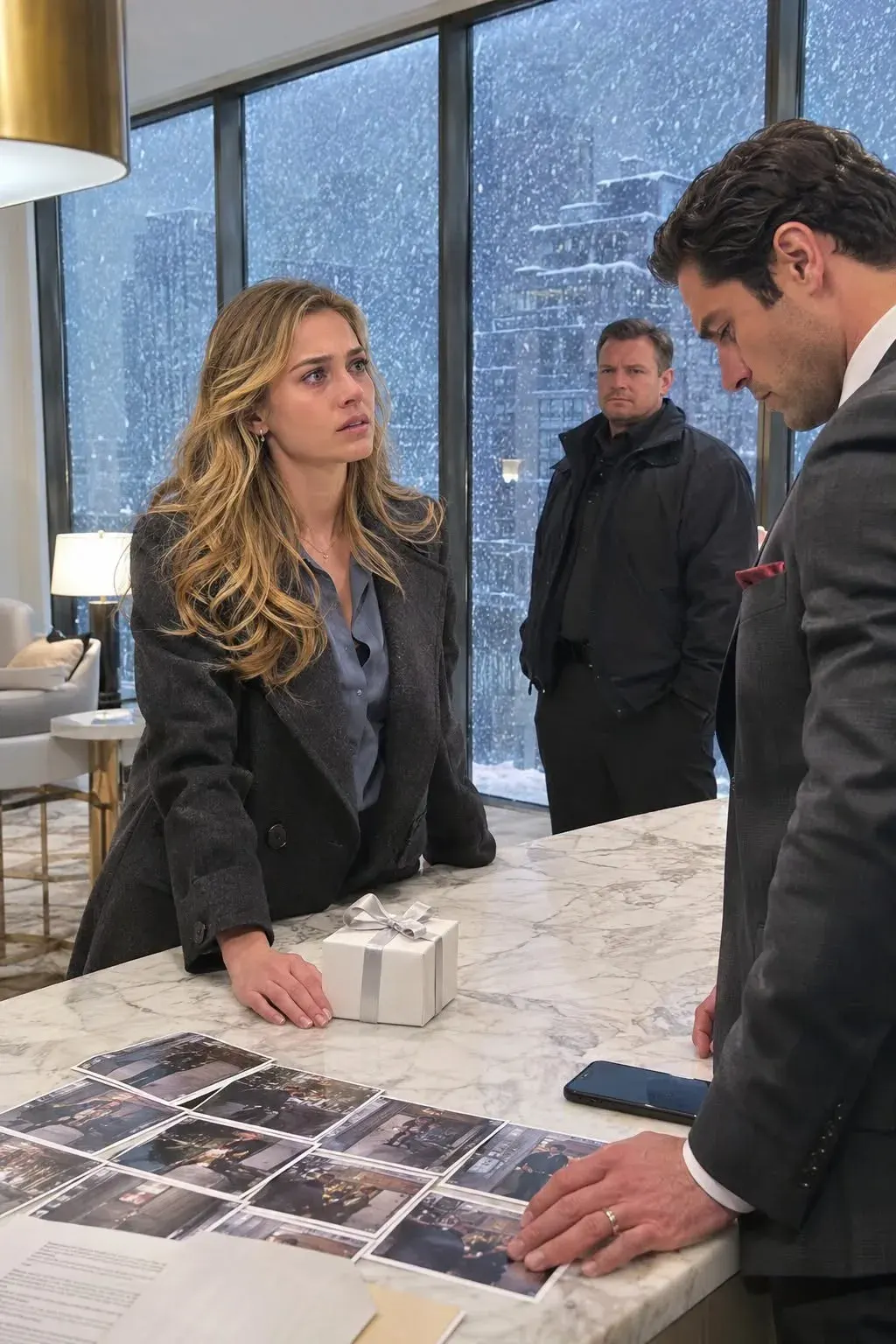
One evening in December, he brought the fourteen photographs to the bakery in a manila envelope and laid them on the table between us. "These belong to you," he said. "Do whatever you want with them."
I fed them one at a time into Eleni's oven, and we watched them curl and blacken behind the glass. Eleni, who had been eavesdropping from the register, announced that it was the best thing that oven had ever baked.
He hired an outside firm to audit every corner of Sterling Harbor and set up an independent ethics board that answered to no one, not even him. Then, without being asked, he separated HopeGuard completely from his company, handing it its own lawyers, its own systems, and an independent board I chose myself.
At twelve weeks, I let him come to my prenatal appointment. When the room filled with the fast, galloping whoosh of our baby's heartbeat, my husband—a man who negotiated billion-dollar deals without blinking—covered his face with both hands and cried.
Through December and January, we rebuilt slowly, the way you rebuild anything worth keeping. We walked along the East River in the snow, argued about baby names over Eleni's lentil soup, and learned to talk to each other without a single document on the table.
Natalie pleaded guilty in January and was later sentenced to nine years in prison. I didn't attend the hearing, because by then I had more important things to do.
In early February, at our twenty-week scan, the technician paused with the wand on my stomach and looked between the two of us. "Would you like to know what you're having?" she asked.
Julian looked at me. "Only if you want to," he said.
I nodded, and she smiled. "It's a girl."
On the way out, the sidewalk outside the clinic was slick with fresh snow, the same kind that had fallen the night he sent me away. Julian walked half a step behind me, the way he had for three months, careful never to presume.
Then I stopped, turned around, and slipped my hand into his for the first time since the blizzard. "Let's go home, Julian," I said.
He looked down at our joined hands as if he were afraid to blink. "Where's home?" he asked.
"Wherever you open the box," I told him.