01 / 10
Chapter 1: Say My Name
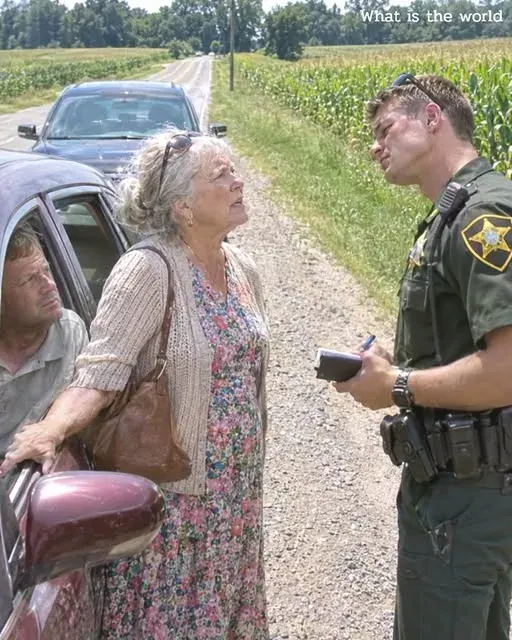
A deputy pulled my seventy-one-year-old mother over on County Road 6, made her stand on the gravel shoulder in the August sun for forty minutes, and laughed that her license looked homemade. So she asked him, very politely, to press the button on his radio and say her name.
It was ninety-one degrees. No shade for a mile. Corn on both sides of the road, tall as a hallway.
I was in the passenger seat of her 2006 Buick LeSabre with a pan of lemon bars on my lap.
My name is Jeffrey Hagen. I'm forty-six, I sell farm insurance out of an office in Alder Falls, Iowa, and that afternoon I was driving with my mother to what she called "a little luncheon at the courthouse." She'd been vague about it for two weeks. She made the lemon bars from my grandmother's recipe at six that morning and wore her good flowered dress, the pale blue one with the white collar.
Mom drives forty-eight in a fifty-five. Always has. She signals for driveways.
The white sheriff's pickup came up behind us just past the Ostrander farm, lights flashing. Mom pulled onto the shoulder, put the car in park, turned off the radio, and folded her hands on the wheel.
"Ten and two," she said to me. "Hands where he can see them, Jeffrey."
The deputy walked up with mirrored sunglasses on. Young. Late twenties. Tan uniform, buzz cut, a jaw like he'd practiced it. His name plate said BRANDT.
"License and insurance."
No hello. No reason for the stop.
My mother handed him her insurance card and the yellow temporary license the Hollis County courthouse gives you while your new card is in the mail. Her old one had expired on her birthday in July. She'd renewed it the same week, but the state was backed up.
He held the yellow paper up to the sun between two fingers like it was a dirty napkin.
"Did you print this at the library, hon?"
Then he laughed. A small laugh, through his nose.
"It's a temporary permit, Deputy," Mom said. "Issued July 14th. The number's on the bottom."
"Step out of the vehicle, ma'am."
She stepped out. Flowered dress. White flats. Handbag on her arm.
"Stand at the back where I can see you."
"She's seventy-one," I said. "It's over ninety degrees out here."
He bent down to my window. I saw myself twice in his sunglasses, small and sweaty. "Sir, you stay in that seat. You get out of this car, you're going to have a very different afternoon."
"Sit still, Jeffrey," my mother said.
So I sat.
He went back to his truck. Engine running. Windows up. I could see him through the windshield, scrolling on his phone.
Ten minutes.
Twenty.
I watched her in the side mirror. She stood perfectly straight, handbag on her forearm. She never leaned on the car. The trunk was too hot to touch. A semi roared past going seventy, and the wind of it whipped her dress against her legs and threw grit into her face. She closed her eyes and waited for it to pass.
At thirty minutes, she walked up to the truck and tapped on the window.
He lowered it two inches.
"May I wait in my car, Deputy? It's very hot."
"You can sit when I tell you to sit," he said, and rolled it back up.
The powdered sugar on the lemon bars had melted clear. The foil was too hot to hold.
Here is what I'm ashamed of.
My mother worked nights in the courthouse basement for thirty-four years. When people asked what she did, I used to say she "just answered phones." I said it like an apology. Like it was a little sad. My friends' mothers were nurses and teachers and bank managers. Mine sat in a basement under the county jail with a headset on.
So I sat there thinking she was nobody to this kid. An old woman with a paper license.
At forty minutes, he came back with his ticket book.
"Driving without a valid license," he said, writing. "And I'm not satisfied that document is real. I'm calling a tow truck. Your vehicle's being impounded, and you'll need to come down to the station and prove who you are."
"Deputy, may I ask one thing first?"
"You can ask."
"Would you press the button on your radio and say my name?" She said it softly, the way she asked the man at Hy-Vee to slice the ham thinner. "Only my name. Shirley Hagen."
He grinned at me through the back window. Then he grinned at her.
"You think you're somebody?"
"No," she said. "I don't think that at all."
He shrugged, still smiling, and keyed the radio clipped to his shoulder. "Dispatch, Unit 14. Run a name for me. Hagen, Shirley. Old gal says I should know who she is." He laughed again. "Says it like she's the governor."
The radio crackled.
Nothing.
Five seconds. Ten. The cicadas screamed in the corn. Brandt's grin started to fade at the edges.
Then a young woman's voice came over the air, unsteady.
"Unit 14, did you say Shirley Hagen? Shirley Hagen is with you? Right now?"
"Affirmative. County Road 6, mile marker 11."
Another pause. Then a different voice. Older. Male. Gravelly.
"Unit 14, this is Sheriff Whitcomb."
Brandt straightened like someone had run a wire up his spine.
"Kyle," the sheriff said, and there was something in his voice I'd never heard from a man with a badge. "How long has she been standing out there?"
Brandt looked at my mother. He looked at his watch. "Sir, she's—I've had her about forty minutes, Sheriff. Expired license, possible forged document—"
"Forty minutes," the sheriff repeated. "In this heat. Shirley Hagen."
"Sir, with respect, I don't know who—"
"No, son," the sheriff said quietly. "You don't. But your father does. Shirley Hagen is the voice that kept your daddy alive on that exact road in 1998. You stand right there. Don't you touch that ticket book. I'm coming myself."
The radio went silent.
Kyle Brandt took off his sunglasses. For the first time, I saw his eyes. They were young. Very young. And very, very frightened.
My mother turned her head toward him and opened her mouth to say something.
Then her knees buckled, and she went down on the gravel.