10 / 10
Chapter 10: What Was Worth Losing
Silas Vale was convicted eleven months later on two counts of first-degree murder, one count of attempted murder, arson, conspiracy, and bribery of a public official. Paulina Greer testified that he had given her a bottle of replacement pills for my father's heart medication, pills that looked identical and contained enough of a cardiac drug to stop a weakened heart within a week. Vanessa Cole's recordings filled two days of testimony. Walter Dunn, on oxygen and leaning on his cane, sat in the witness box and apologized to Evelyn in front of the entire city.
Silas was sentenced to life without parole. He never once looked at either of us in the courtroom.
The Westerly Maritime accounts held a hundred and twenty million dollars. The court returned what could be traced to the Vale and Mercer estates. Evelyn used the Mercer share to rebuild Warehouse Seven and to open a burn recovery center at Greyhaven General, named after her parents.
A month after the verdict, a judge dissolved the Vale-Mercer Joint Trust and declared Clause 14(c) void, along with our entire marriage contract, on grounds of fraud.
Legally, we were free. There was nothing holding either of us anymore.
I asked Evelyn to dinner that night. Not at a private club or a famous restaurant. At a small Italian place on Dock Street with paper tablecloths, where nobody knew who we were and the owner's grandmother sang along to the radio in the kitchen.
"The contract's gone," I said, after the second glass of wine. "The trust is gone. Silas is gone. You don't owe me anything. You can have your terminals and your life back, and nobody in Greyhaven would blame you."
She set down her fork. "Are you asking me to leave, Roman?"
"I'm asking you to stay." I took a small velvet box from my pocket and opened it. It wasn't a Vale family heirloom. It was a simple gray pearl, the exact color of her eyes, that I'd chosen myself. "Not because of a contract. Not because of my uncle. Because I want to wake up every day for the rest of my life being outthought by you."
She looked at the ring for a long moment. Then she laughed—a real laugh, surprised and unguarded, the first one I'd ever heard from her.
"Yes," she said. "Obviously yes. You're terrible at proposals."
"I've never done one before."
"Clearly."
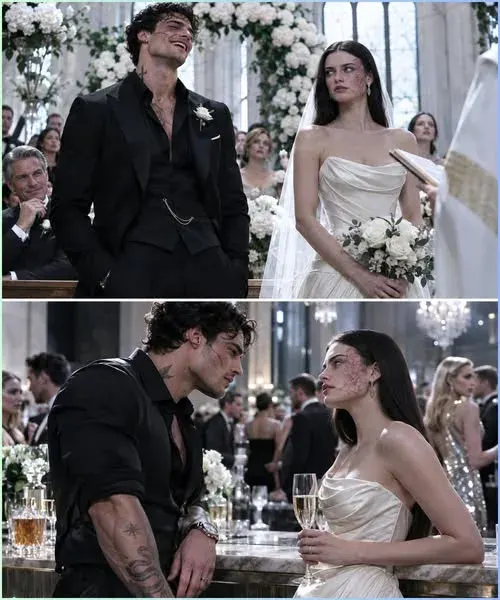
We married again in the spring, at St. Augustine Hall, in front of sixty people instead of three hundred. Theo walked his sister down the aisle. Marco was my best man. Detective Hale came and sat in the back row and cried, then denied it. Walter Dunn sent white roses from his hospital bed.
Evelyn wore ivory again, with her hair swept back from her face, the scar shining pale in the candlelight, and she walked toward me exactly the way she had the first time—like a woman approaching a negotiation she fully intended to win.
When she reached me, I laughed.
She raised one eyebrow. "Something funny?"
"My life," I said. "Apparently. I can't believe I almost missed it."
The first time I saw my wife, I laughed because the whole city had told me she was ugly. The second time, I laughed because I finally understood what they'd been too blind to see: the most beautiful thing in any room is the person who walked through fire to get there and never once lowered her eyes.


