01 / 10
Chapter 1: I Called Grandma Four Times
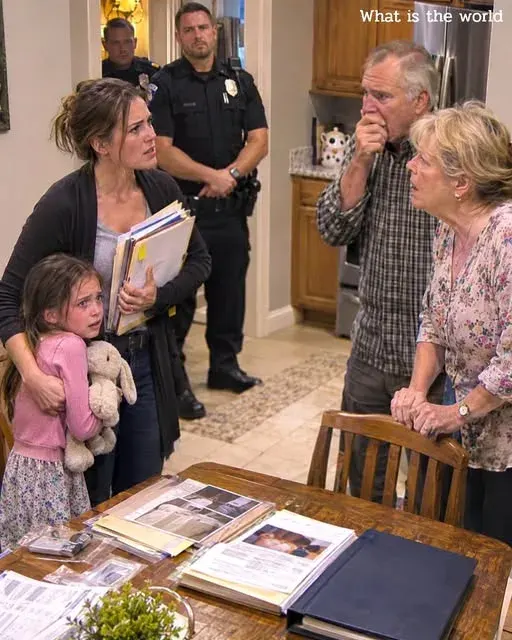
When my parents finally came home after midnight, my niece had already told the police everything. My mother pointed at me and screamed, "She kidnapped Emily!" Then Emily stepped forward and said softly, "I called Grandma four times." The room went silent. But the real shock came when I opened my folder and placed six months of evidence on the table.
That was when my father stopped smiling.
It started with a phone call at 11:22 on a Friday night.
"Aunt Claire," my six-year-old niece whispered, "I'm hungry. And the lights keep flashing."
Then she said something worse.
"Grandma and Grandpa said not to call anybody, because nobody checks on family."
My name is Claire Whitfield. I'm thirty-three, and I work as an insurance fraud investigator in Charlotte, North Carolina. My job is to notice when a story doesn't match the evidence. For six months, I had been noticing exactly that about my own parents.
Eighteen months earlier, my younger sister, Megan, died of a brain aneurysm at twenty-eight. She collapsed in the cereal aisle of a Harris Teeter on a Tuesday morning and never woke up. She left behind a four-year-old daughter named Emily, with Megan's gap-toothed smile and her habit of humming when she was nervous.
Then came the guardianship fight.
My parents, Robert and Diane Whitfield, told the court I was too focused on my career. Too busy. Too independent. Too inexperienced with children. My mother cried in front of the judge. "Emily needs stability," she said, and described herself and my father as the safe, dependable choice. They had the house in Matthews. The routine. The time. And they had a will Megan signed when Emily was a baby, naming them as guardians.
They won.
For months afterward, whenever I asked about bruises, missed school days or Emily's constant hunger, Mom said I was bitter. "You lost," she'd say. "Stop trying to steal our granddaughter."
So I stopped asking loudly. I started paying attention instead.
That night, with thunder shaking my apartment windows, there was nothing left to ask.
"Stay where you are, sweetheart," I said. "I'm coming."
Twenty minutes later, I pulled into my parents' driveway through sheets of rain. The house was dark. No porch light. I ran to the door and let myself in with the spare key Megan had given me years ago, the one my parents didn't know I still had.
I found Emily curled beneath the kitchen table in pajamas, clutching an empty box of Cheerios and a stuffed bunny with one ear. Water was dripping through the ceiling near the back door. And on the counter, beside a stack of paper towels, a candle was burning.
An open flame. In a house with no adult in it. Beside something that could catch fire in seconds.
My hands shook as I pinched it out.
"How long have they been gone, baby?"
She held up six fingers.
It was almost midnight. Six hours.
I opened the refrigerator because something in her voice told me to. Three bottles of champagne. Expensive brie. Restaurant leftovers in a gold-foil box. No milk. No fruit. Nothing meant for a child.
"Grandma says I eat too much," Emily whispered behind me.
I closed the refrigerator door gently. Not loudly. I didn't want her to think telling the truth had been a mistake.
"You're not in trouble," I said.
"I called Grandma four times. She didn't answer."
I wanted to scream. Instead, I took out my phone and photographed everything. The empty shelves. The leaking ceiling. The candle. Emily's dirty pajamas. The thermostat, set to fifty-eight degrees with the heat switched off on a cold March night. I took wide shots of every room so nobody could ever claim I'd staged a thing. I checked the time stamps.
Then I called the police.
Officers Danielle Brooks and Marcus Hill arrived at 12:31. Officer Brooks, a tall woman with a soft Georgia accent, knelt and spoke to Emily for ten minutes while I made her a peanut butter sandwich from a jar I'd brought in my bag. Emily ate it in four bites. Officer Hill walked through the house with a flashlight, writing.
At 1:07 a.m., headlights swept across the front windows.
Through the glass, I watched my parents walk up the path beneath a golf umbrella, laughing. Mom was in a sequined black top. Dad wore his good leather jacket. Both still had glowing VIP concert wristbands on their arms.
Then they saw the two patrol cars. Mom's smile vanished.
They came in wet and loud. Mom saw me standing in the kitchen with Emily pressed against my side, wrapped in my coat, and her face twisted.
"What the hell did you do?" Dad said.
"Nothing," I said quietly. "I just finally stopped protecting you."
Mom spun to the officers and jabbed her finger at me.
"She kidnapped Emily! She broke into our house! We have full custody. Arrest her!"
"Ma'am," Officer Brooks said evenly, "your granddaughter called her aunt for help."
"That's a lie. Emily doesn't even have a phone."
Then Emily stepped out from behind my coat. Tiny, barefoot, still holding the bunny.
"I used the kitchen phone," she said softly. "I called Grandma four times first."
The room went silent. Even the rain seemed to stop for a second.
Officer Hill turned his notebook around. "Your call log shows four missed calls from this house between 9:40 and 11:15, Mrs. Whitfield. Did you not hear your phone?"
Mom opened her mouth and nothing came out.
My father recovered first. He always did. He chuckled, that low, dismissive laugh I'd heard every time I questioned anything about Emily, and put his hand on my mother's shoulder.
"Officers, I'm sorry you got dragged into this. My daughter lost a custody case to us last year, and she's been obsessed ever since. We hired a sitter. The sitter must have left early. Claire sees a chance and turns it into a crime scene." He looked at me with pity. "You really think anyone's going to believe your revenge fantasy, Claire?"
"What's the sitter's name?" Officer Brooks asked.
Dad hesitated for one half-second. "Ashley."
"Last name?"
"I'd have to check."
I set my canvas bag on the kitchen table. I took out a thick blue accordion folder, the kind I use at work for claims that are going to court, and I opened it.
"There was no sitter," I said. "There's never a sitter. I've documented it."
I laid the pages out on the table, one stack at a time, under the flickering kitchen light.
"Emily's school attendance records. Thirty-one absences in the first semester of kindergarten. The excuses you gave the school, in your own handwriting, Mom. Strep, a family emergency, a dentist appointment. On nine of those days, your Facebook shows you at brunch, at a winery in Asheville and at the beach in Myrtle."
Mom stared at the paper.
"Two missed pediatrician appointments. A school nurse report from April about a bruise on Emily's arm shaped like fingers. Your explanation to the nurse, and your different explanation to me, three days apart."
I put down another stack.
"Texts from you telling me Emily was 'with friends' on three Saturdays when her teacher saw her sitting alone on your porch at seven p.m."
Dad was still smiling, but it had gone stiff at the edges.
"And this." I placed the last document on top. "Megan's life insurance paid four hundred thousand dollars into a trust for Emily. You two are the trustees. I obtained the account statements legally through the trust's annual report, which you're required to send to Emily's next of kin and never did, so I requested it from the bank directly. In eighteen months, you've withdrawn two hundred twelve thousand dollars. A Lexus. A Caribbean cruise. A kitchen remodel. And at 4:15 this afternoon, two VIP concert tickets. Two thousand four hundred dollars. Charged to Emily's trust."
I looked at my father.
"You left her alone in the dark tonight, at a concert her dead mother paid for."
My father stopped smiling.
Officer Hill picked up the bank statement and read it twice. Officer Brooks stepped closer to Emily, her body angled between my parents and the child.
"That money is for her household," Mom snapped, her voice going high and shrill. "We're her guardians. It's legal. Megan wanted us to have her. The court agreed. You have no standing, Claire. None. You're nobody."
"Mrs. Whitfield," Officer Brooks said, "I've contacted the county's after-hours child protective services line. A caseworker is on her way. Given what we've seen tonight, Emily won't be staying here."
"Over my dead body," Mom said. "She's ours. Megan chose us."
And that was when Emily tugged my sleeve.
She was holding her one-eared bunny upside down. She worked her small fingers into a seam along its back, where the stitching had been redone with blue thread, and pulled out a square of paper, folded small and tight and soft from being hidden for a very long time.
"Mommy said if Grandma ever stopped being nice," Emily whispered, "give this to Aunt Claire. Mommy said it was a secret till then."
My mother's face went gray.
"Where did she get that?" she breathed.
I unfolded the paper with shaking hands. It was a photocopy, creased in eight places. At the top, in bold type, it said Last Will and Testament of Megan Anne Whitfield. In the margin, in my sister's round, looping handwriting, were four words.
Claire. Don't let them.
The will was dated three weeks before Megan died. And the second paragraph made the floor fall away beneath me.
I hereby revoke all prior wills. I name my sister, Claire Elizabeth Whitfield, as the sole guardian of my daughter, Emily.
I looked up.
My father wasn't looking at the will. He was looking at my mother. And he didn't look surprised at all.
He looked caught.


