09 / 10
Chapter 9: Twenty Weeks
Thomas asked if he could come to the twenty-week ultrasound.
He asked through Amanda, in writing, the way I'd requested. The email was short. "I know I don't deserve it. I'd like to be there. I'll stand wherever she tells me to stand. I won't speak unless she wants me to."
I said yes. Not for him. For the baby, who would one day ask me whether her father had seen her before she was born.
He flew to San Diego and met me at the clinic in Kearny Mesa in January. He wore a plain gray sweater. He'd lost weight. When he saw my father in the waiting room, he nodded respectfully and didn't try to shake his hand.
In the dim exam room, he stood against the far wall, exactly as he'd promised.
The technician spread cold gel across my stomach and moved the wand, and suddenly there she was on the screen. Not a gray bean anymore. A profile. A tiny nose. A hand pressed against her cheek like she was thinking very hard about something.
"Do you want to know the sex?" the technician asked.
"Yes," I said.
"It's a girl."
I heard a sound from the corner of the room and turned. Thomas had his hand over his mouth. Tears were running down his face, silent and steady.
After the appointment, we sat on a bench outside the clinic. My father waited in the car, watching us through the windshield like a sentry.
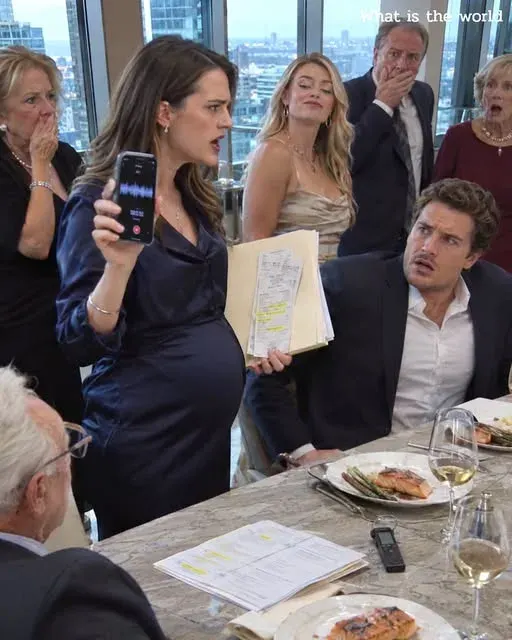
"I listened to it," Thomas said after a long silence. "The recording. Pruitt made me listen to the whole thing. I hadn't heard myself say those words in two years, and I didn't recognize that guy. I didn't want to." He stared at his hands. "Brenda used to tell me, ever since Dad died, that women leave. That I had to protect myself. And I let her turn every good thing you did into a threat. You paid for everything, and I told myself you were trying to control us. Because if you were controlling us, I didn't have to feel grateful. I didn't have to feel small."
I didn't say anything. I'd learned from Amanda that silence makes people tell the truth.
"I'm in therapy now," he said. "Twice a week. I'm not asking for anything. I know what I did. I know it was on purpose." He looked at me, and for the first time in years, he looked like the man I'd married. Uncertain. Human. "I just want to be a decent father to her. Even if I was a terrible husband to you."
"Then be one," I said. "Show up. Pay on time. Never let anyone in your family speak about her mother the way they spoke about me."
"I won't," he said. "I swear to you."
Joyce called me the following week. She had sold the house to a couple from Minnesota. She had moved into a small apartment near her church in Mesa. She'd mailed me a check for eleven thousand four hundred dollars, which I hadn't asked for.
"It's not about the money," she said on the phone. "I needed to give it back so I could look at myself in the mirror. And I needed to say this out loud. I'm sorry, Emma. I watched them treat you like a bank and a nuisance at the same time, and I laughed. I'd like to know my granddaughter, if you'll let me. But I understand if you won't."
"Let's start with a phone call once a month," I said. "And see."
Brenda never apologized.
She left a single voicemail in February, two minutes long, in which she blamed me for Tyler's withdrawal from Desert Vista, for her bankruptcy filing, for her brother's divorce, for her mother's move, and for "poisoning Tyler against his own family." She said I would regret what I'd done.
I listened to it once. Then I saved it to my drive, in a folder labeled "Reed," where it would sit forever alongside seven years of receipts.
Some people never stop believing that the person who stops paying for them is the villain. I'd stopped needing her to understand.