01 / 10
Chapter 1: Eleven Minutes
At 2:14 on a gray Tuesday afternoon in November, a doctor told me I had leukemia, and at 2:25 my husband walked back into the room with his lawyer and gave me forty-eight hours to get out of our penthouse. Nathaniel Costello thought he was throwing a sick, useless wife out of his life—he had no idea that every floor he stood on had belonged to my father.
The man I married ran the most powerful crime family on Chicago's North Side—and, after our wedding, a large piece of the South Side too. I had been Serena Gallagher Costello for five years, and I was thirty-two, when I found out what that marriage was worth to him.
That piece had been my father's. For forty years, Declan Gallagher kept the peace from Beverly to Canaryville with a low voice and a long memory—no drugs on his corners and no shopkeeper paying for protection he didn't need.
When I married Nate at twenty-seven, my father shook his hand at the altar, folded his crew into the Costello organization, and retired to his tomato garden. Two summers ago, his heart gave out among those vines on a hot August morning, and after that, I was the only Gallagher left in my husband's world.
For three months, I had been finding bruises I couldn't explain—purple thumbprints on my shins, a yellow bloom on my wrist from nothing harder than a seat belt. I blamed the night sweats on the gala I was chairing and the exhaustion on lying awake until two in the morning, waiting for Nate to come home smelling of someone else's perfume.
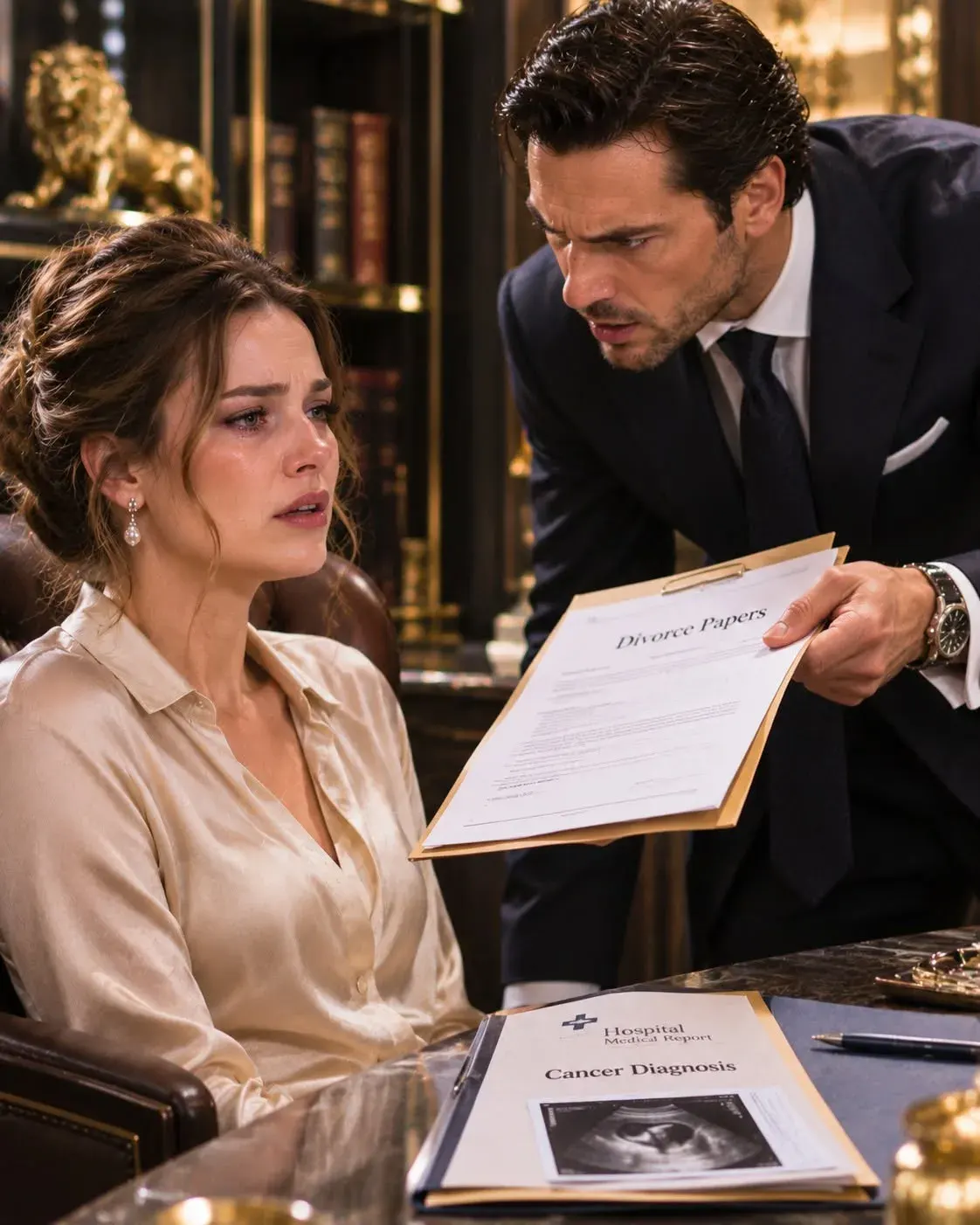
When Dr. Harrison Caldwell—my father's oldest friend and the best hematologist in Chicago—asked me to come to his private office at the Halloway Clinic on East Erie Street, I knew. The room looked more like a judge's chambers than a clinic—dark wood shelves of leather-bound books, a polished black marble desk, brass lamps glowing gold against the rain, and a small gold lion my father had given him years ago, for courage.
I wore my hair pinned up in a loose knot, my champagne silk blouse, and the pearl drop earrings my father bought me for my wedding, because some foolish part of me believed bad news couldn't find a woman who looked put together. Nate sat beside me in his navy suit, his dark hair slicked back and his phone face-down on his knee, already bored.
"Acute myeloid leukemia," Dr. Caldwell said, opening a folder marked Cancer Diagnosis with a scan printout clipped to the cover. "It's a cancer of the blood and bone marrow, Serena, and it moves fast—which means we have to move faster."
I reached for my husband's hand. Nathaniel slid his wrist away and turned it over to check his silver watch.
The gesture was so small that I spent the next few seconds explaining it away—he was nervous, he would turn his palm back toward mine any moment. He never did.
"How long will she be out of commission?" Nate asked, as if I were a racehorse with a bad leg.
Dr. Caldwell kept his eyes on me. "Months of intensive chemotherapy, possibly a transplant, and she'll need someone beside her for every one of those months," he said evenly.
Nate stood, buttoned his jacket, and said, "Excuse me." The heavy door clicked shut behind him.
I stared at that door while the clock above the bookshelves ticked, telling myself he needed air. When Dr. Caldwell slid a box of tissues across the marble and asked who else he could call, I insisted my husband would be right back.
At 2:25, the door opened.
Nate came in first, with Jonathan Pierce behind him carrying a black briefcase. In five years of Christmas parties, I had never seen Jonathan open that briefcase unless someone was about to lose something.
Dr. Caldwell half rose from his chair in protest, but Nate didn't even look at him. Jonathan set a silver pen on the marble and murmured something about fifty thousand dollars under the agreement I had signed before the wedding, adding, almost too low to hear, that I should have my own attorney look it over. Nate took the papers from him, laid them on a manila folder, and leaned over my leather armchair until his shadow covered my lap.
"You have forty-eight hours to leave the penthouse."
The tears came before I could stop them, rolling hot down my cheeks and onto the silk. "Nate... my treatment," I said, my voice breaking down the middle.
His jaw tightened, and his dark eyes were as flat and impatient as a man waiting on a slow elevator. "You're a Gallagher. Go back to your father's people."
I looked up at him and could barely push the words out. "My father is dead."
Nathaniel dropped the divorce papers on top of my cancer report, right over the gray shadow of my own bone marrow. "Then use the money wisely," he said, and he walked out without looking back.
Jonathan hesitated at the door as if he wanted to say something more, then followed his client.
I sat absolutely still. Then my tears stopped, the way a faucet stops when someone finally turns the handle.
I looked down at the unsigned papers lying on my diagnosis and heard my father's voice on the morning of my wedding, while he fastened these same pearls in my ears—if he's ever cruel to you, sweetheart, don't cry, call Maggie. I placed two fingers on the stack and pushed it calmly across the marble, away from me.
I glanced at the clock and did the arithmetic. From 2:14 to 2:25—eleven minutes was all it had taken my husband of five years to decide I was a liability.
"Serena," Dr. Caldwell said, closing the folder. "Now we're going to talk about keeping you alive."
"Yes," I said, steadier than I had any right to be. "But first, I need to make one phone call."
I dialed a number I hadn't called since my father's funeral, and a raspy South Side voice answered on the first ring. "I've been waiting five years for this call, sweetheart," Margaret Doyle said. "Should I bring the green box?"