02 / 10
Chapter 2: The Girl Who Disappeared
I need to tell you why my husband never knew who I was. It wasn't an accident. It was the best decision I had ever made, until the night it nearly killed me.
I grew up in a stone house on Habersham Road in Atlanta with a mother who ran one of the most quietly powerful private lenders in the South. Margaret Rowan didn't do interviews. She didn't attend galas unless she was funding them. She lent money to developers, hospitals, and shipping companies, and she had a rule she repeated at breakfast like a prayer: "Money tells you what people are. It never tells you who they are."
When I was twenty-five, I learned what that meant. I was engaged to a charming lawyer named Bradley Kemp, and two weeks before the wedding, Frank Delgado placed a recording on my mother's desk. Bradley, drunk at his bachelor party, explaining to his friends that he could "put up with the Rowan girl for ten years" if the prenup was soft enough.
I cancelled the wedding. The society pages turned it into a circus. Photographers followed me to the grocery store. A tabloid printed my face beside the headline Atlanta's Loneliest Heiress.
So I disappeared. I moved to Charlotte, dropped my last name from everything I could legally drop it from, and took a job as an analyst at a private investment office my mother quietly owned. I rented a two-bedroom apartment in Plaza Midwood, drove a used Honda, and promised myself that the next man who loved me would love Emily, not Rowan.
Caleb Whitaker found me in a coffee shop on Central Avenue in the rain, when he was a thirty-year-old developer with one half-finished building and a mountain of debt. He spilled his coffee on my laptop and paid for the repair with a credit card that declined twice. I laughed. He laughed. He asked me to dinner, and I said yes because he seemed like a man with nothing to hide behind but his smile.
We married fourteen months later at a small chapel near Lake Norman. My mother came in a plain gray dress and introduced herself as "Emily's mom, Maggie." Caleb shook her hand politely and forgot her name by the reception.
Six months after the wedding, Caleb's first tower was weeks away from collapse. The bank had pulled his credit line, and his contractors were filing liens. He came home and sat on the kitchen floor with his head in his hands, and I loved him enough to do something I swore I would never do.
I called my mother.
Rowan Capital stepped in through a holding company called Habersham Lending Group. Caleb got his loan. Then he got another, and then two more. Four towers rose over Charlotte, each built on Rowan money, and each loan carried a guarantee co-signed by a trustee whose name was printed only as E. M. Rowan.
Caleb thought Habersham Lending was a sleepy fund run by retirees who didn't read their files. He bragged about it at dinner parties. "Dumb money," he called it. "They just keep writing checks."
I sat beside him and smiled and said nothing. I told myself it was a gift he never needed to know about. My mother told me it was a test.
"Watch what he does when he thinks he's winning, baby girl," she said, on the porch in Atlanta the summer before her stroke. "That's when people show you their real face."
She was right. When the towers filled with tenants and the billboards went up, Caleb changed. He hired Vanessa. He started sleeping in the guest room "because of my snoring." He took calls in the garage. And last spring, while he was in Miami for a conference, an envelope arrived at our house addressed to him from a bank in Wilmington, Delaware.
I opened it. Inside was confirmation of a new account in the name of Crane Whitaker Holdings, with an opening balance of three point one million dollars, and a personal guarantee bearing my signature.
I had never seen that document in my life.
That night, I drove to Diane Mercer's office in Atlanta and put the envelope on her desk. She read it twice, took off her glasses, and said, "Your husband is committing bank fraud against his own lender, using his wife's forged signature, and he doesn't know the lender and the wife are the same person."
"What do I do?"
"Nothing," she said. "You let him keep going until we can prove everything. And you never, ever let him know you know."
For eleven months, I kept that promise. I found out I was pregnant. I smiled at Vanessa at the company Christmas party. I let Caleb kiss me goodbye in the mornings, and I gathered copies of every statement, every wire transfer, every forged page.
My mother had her stroke in May. She lived, but she lost most of her speech and the use of her right hand. Under the trust, controlling authority passed to me within forty-eight hours. I sat beside her hospital bed in Atlanta with documents on my lap, and she squeezed my fingers with her good hand and managed two words.
"Be careful."
I thought I had been. I thought my only mistake would be telling Caleb too early. I never imagined that he would open a car door at thirty miles an hour.
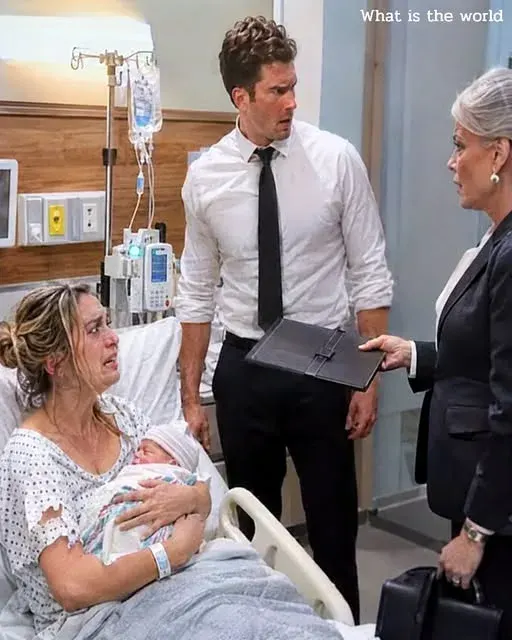
Now, at four in the morning in Mercy General, with my newborn son sleeping in a plastic bassinet and Vanessa Crane in a holding cell downtown, Frank Delgado knocked on the door of my room.
His face was pale.
"Emily," he said quietly. "A woman just tried to check the baby out of the nursery. She had a hospital badge and a signed release from the father."
I was out of the bed before the pain even registered.