01 / 10
Chapter 1: Thrown Into The Rain
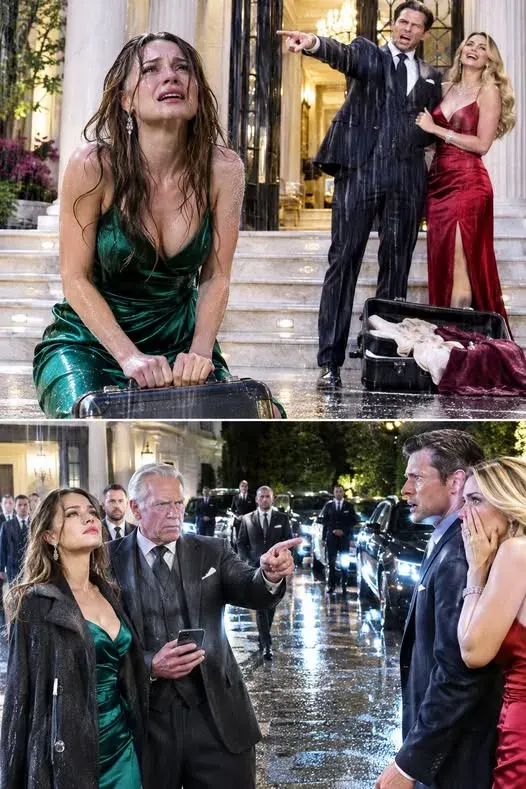
My husband threw my suitcase into the pouring rain, then shoved me out the front door of our mansion while his mistress laughed behind him and two hundred guests watched through the windows.
"You were nothing when I found you, Emily," he sneered. "And you'll be nothing when I'm finished with you."
It was supposed to be the happiest night of his career.
My name is Emily Bennett. I was thirty-two years old, and for six years I had been married to Daniel Bennett, founder and CEO of Bennett Construction, one of the fastest-growing builders in Boston.
That Saturday was the company's tenth anniversary. Daniel had insisted on hosting the party at our home in Wellesley, a white stone mansion on three acres with a circular driveway, a glass-walled ballroom, and a fountain I had picked out myself.
I had spent five years turning that house into a home. I had chosen every rug, every lamp, every bowl of white peonies on every table. I had planned that party for two months, down to the oysters, the jazz trio, and the ice sculpture of the company logo melting slowly by the bar.
Daniel had barely spoken to me in weeks. I told myself it was stress.
By nine o'clock, the ballroom was full. State senators. Bankers. Developers. Half of Boston's construction industry, drinking champagne under crystal chandeliers while rain hammered against the glass walls.
I was crossing the room in a pale blue silk dress when I saw her.
Vanessa Collins. Twenty-eight. Long, glossy blonde waves and a tight red satin dress. The daughter of Howard Collins, the real estate developer whose name was on half the cranes in the Seaport.
And around her neck, sparkling under the chandelier, was my necklace.
A cascade of diamonds set in platinum. Daniel's gift to me on our fifth anniversary. The last time I'd seen it, it had been in the velvet box in my dressing room.
I stopped in the middle of the dance floor.
Vanessa saw me looking and touched the stones with two fingers, smiling sweetly.
Before I could say a word, the jazz trio stopped. Daniel stepped onto the small stage by the windows, tapping a microphone. He was handsome in a dark gray suit, his black hair slicked back, his jaw sharp, his smile practiced.
"Ten years ago, I started Bennett Construction with one truck and a lot of debt," he said. Polite laughter. "Tonight, I'm proud to announce our next chapter. Bennett Construction is entering a strategic partnership with Collins Development for the Harbor Point Tower project in the Seaport. Three hundred and forty million dollars."
Applause swept the room.
"And I'd like to thank the woman who made it possible," he went on, holding out his hand. "My partner. In every sense of the word. Vanessa Collins."
Vanessa floated up onto the stage and kissed him on the mouth in front of two hundred people.
The applause died in ragged pieces. Someone dropped a glass. Every head in the ballroom turned to look at me.
I couldn't breathe. My face burned. I could feel the stares on my skin like heat from an oven.
Daniel looked straight at me from the stage, and there was nothing in his eyes. No guilt. No hesitation. Just impatience, like I was a delivery that had arrived on the wrong day.
"Daniel," I said, and my voice carried across the silent room. "What are you doing?"
He stepped down from the stage, Vanessa on his arm, and walked toward me while the crowd parted around us.
"What I should have done a long time ago," he said. "Let's not make a scene, Emily. Go upstairs. Your things are packed."
"My things?"
"Maria packed your bags this afternoon." He nodded toward the front hall, where our housekeeper stood with her eyes lowered, wringing her hands beside two suitcases. "You're leaving tonight."
A woman near the bar gasped. A banker I'd had dinner with a dozen times suddenly found his shoes fascinating.
"That's my necklace," I said, looking at Vanessa.
Vanessa laughed. A bright, tinkling laugh, like breaking glass. "Was," she said. "Daniel says it never really suited you."
"Don't look so surprised," she added sweetly. "Men like Daniel deserve women who actually belong in their world."
Daniel wrapped an arm around her waist.
"She's right," he said, loud enough for the guests to hear. "I married you because I thought you were different. Humble. Grateful. But you're just an ordinary orphan who got lucky. I gave you this house. This life. And you've given me nothing but charity dinners."
I stared at the man I had once loved more than anything in the world.
Six years earlier, I had met Daniel while volunteering at a community hospital in Dorchester. He was thirty, ambitious, charming, and drowning in debt. I had helped him rewrite his investment proposals. I had introduced him to business contacts he never could have reached on his own. I had quietly kept his struggling company alive when the banks turned their backs on him.
He never asked where those contacts came from.
He never asked why a supposedly penniless orphan understood corporate finance better than his accountants.
"Daniel," I said quietly, "are you certain this is what you want?"
He laughed. "Absolutely. Vanessa's father can take Bennett Construction into the big leagues. What can you offer me? Another bake sale?"
Vanessa burst out laughing. A few guests laughed with her, nervously, the way people do when they want to be on the winning side.
Daniel strode to the front hall, grabbed the larger suitcase, threw open the tall glass doors, and hurled it down the marble steps. It burst open on the wet driveway. My sweaters, my books, my mother's old photo album, all of it spilled into the rain.
Then he took my arm and pushed me out the door.
I stumbled barefoot onto the cold marble steps. My heels were still upstairs. Rain soaked through my silk dress in seconds.
Behind him, faces pressed against the ballroom windows. Some of them were filming.
Daniel tossed a folder at my feet. It landed in a puddle.
"Divorce papers," he said. "Sign them by Monday. You're not getting a cent."
I bent down and picked up the folder. Through the plastic sleeve, I could read the first pages. He wanted the house, the company, and every asset accumulated during our marriage.
He had also included a signed statement, sworn under penalty of perjury, claiming I had never contributed financially to Bennett Construction in any way.
That was his first mistake.
His second was believing I had nowhere to go.
I knelt in the rain and gathered my mother's photo album against my chest. Then I picked up my suitcase and stood.
"Goodbye, Daniel."
He slammed the door. Through the glass, I watched Vanessa hand him a fresh glass of champagne. The jazz trio started playing again.
For a moment, I stood motionless at the bottom of the steps, feeling the cold water run down my face and mix with my tears.
Then I reached into the pocket of my trench coat, which Maria had quietly draped over my suitcase, and took out my phone.
I scrolled to a number I hadn't dialed in six years.
It rang once.
"Emily?"
His voice was exactly the same. Deep. Careful. Like he was afraid that if he spoke too loudly, I might disappear again.
"Dad," I whispered. "I'm ready to come home."
There was a long silence on the line. I could hear him breathing.
Then the voice of Richard Whitmore, chairman of Whitmore Global Holdings, one of the largest private investment firms in the country, turned dangerously calm.
"Where are you, sweetheart?"
I told him.
"Stay exactly where you are."
Twenty minutes later, headlights appeared through the rain at the end of the long driveway.
Not one car. Six black luxury sedans, gliding up the circular drive one after another like a funeral procession.
Inside, the music stopped again. Guests crowded against the glass. The front doors swung open, and Daniel stepped out onto the top step with Vanessa behind him, squinting into the headlights.
The rear door of the first car opened. A tall man in a long black overcoat stepped out, silver-haired, silver-bearded, holding a large black umbrella.
He walked straight past the fountain, past the spilled sweaters, and stopped beside me. He lifted the umbrella over my head, and for the first time in six years, I wasn't standing in the rain alone.
Then he looked up at my husband.
Daniel's face went white. He had spent three years trying to get a single meeting with this man. He had a framed magazine cover of him in his home office.
"Mr. Whitmore?" he stammered. "Chairman Whitmore? I, sir, what are you doing here?"
My father's voice carried over the rain like a judge reading a sentence.
"I came for my daughter."
Behind Daniel, Vanessa's champagne glass slipped from her fingers and shattered on the marble.
"Your daughter?" Daniel whispered.
My father looked at the necklace glittering on Vanessa's throat, then back at the man who had just thrown me out of my own home.
"You threw away a diamond," he said, "to pick up a cheap piece of glass."
He turned his back on them, guided me into the car, and closed the door.
As the sedan pulled away, I watched Daniel through the rain-streaked window, standing frozen on the steps with two hundred witnesses behind him.
My father took out his phone.
"Who are you calling?" I asked.
"Gerald Fitch. President of Atlantic Commonwealth Bank. We own it. Bennett Construction's entire sixty-million-dollar credit line runs through it." He pressed a button. "By morning, your husband won't be able to buy a box of nails."
"Dad, wait."
He paused, the phone halfway to his ear.
I looked down at the soaked divorce papers in my lap. At the sworn statement that said I had never contributed a single dollar to Daniel's company.
"Before you do anything," I said, "there's something you don't know. Four years ago, Bennett Construction was two weeks from bankruptcy. A private investor called Ashford Capital saved it with eight million dollars."
My father frowned. "I remember. A small family office in Connecticut."
"It isn't in Connecticut," I said. "It's me. I own forty percent of Daniel's company. And he has no idea."