01 / 10
Chapter 1: Learn To Live Alone
My daughter-in-law raised a glass of my wine at my dining table and told me it was time I learned how to live by myself. She had lived under my roof for twelve years without paying a dollar of rent, and now she spoke as if the house were hers to hand out. What she didn't know was that ninety minutes earlier, my attorney had filed documents she never imagined existed.
My name is Eleanor Hayes. I am sixty-seven years old, a retired high school librarian, and for thirty-four years I have lived in a two-story brick Colonial on Grove Avenue in Richmond, Virginia, with black shutters, a magnolia tree in the front yard, and a porch swing my husband Thomas hung the summer we moved in.
Thomas died of a heart attack in the spring, twelve years and some months ago. He was sixty-one. He went out to the garden to stake the tomatoes and didn't come back in.
That fall, my only son, Connor, lost his job at a logistics company that went under. His wife, Melinda, was seven months pregnant with their first child. They arrived on my porch one rainy September evening with four suitcases, a crib still in its box, and more fear in their faces than either of them was willing to say out loud.
"Just a couple of months, Mom," Connor said. "Until I find something."
"Stay as long as you need," I told him.
I meant every word. The house was too big and too quiet without Thomas, and I was grateful for the noise.
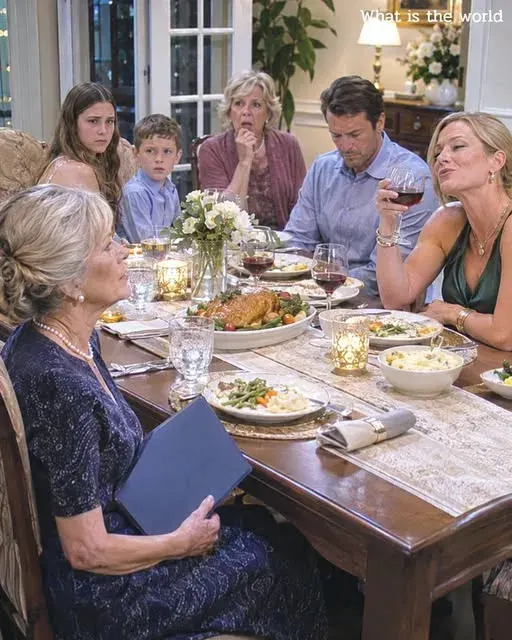
That Sunday evening, twelve years later, the whole family was gathered around my oak table for what Melinda had called "a little celebration." I had roasted two chickens and made my mother's mashed potatoes with too much butter. My younger sister, Ruth, had driven in from Petersburg with a peach cobbler. My grandson, Jackson, now eleven and suddenly all elbows, sat beside his sister, Lily, twelve, who had her grandfather's serious brown eyes and his habit of watching everyone before she spoke.
Melinda waited until the plates were full. Then she tapped her glass with a fork and stood.
"We have an announcement," she said, glowing in an emerald wrap dress I had never seen before. "Connor and I finally bought our own house."
The table erupted. Ruth clapped. Jackson shouted, "Do I get my own bathroom?" Lily asked whether the house had a backyard and whether she could paint her room purple. Connor smiled at his plate with a sheepish kind of pride, and I smiled too, because I was genuinely happy for them. For twelve years, I had wanted nothing more than to see my son stand on his own feet.
"Four bedrooms in Midlothian," Melinda said. "Whitmore Court. We closed on Friday."
"That's wonderful," I said, and raised my glass.
But Melinda was watching me over the rim of hers.
After twelve years under one roof, I knew that look. It was the look she wore when she'd been saving something, rehearsing it in front of the bathroom mirror, waiting for the perfect moment and the perfect audience. The house was news for everyone. What came next was meant only for me.
She sat back down, crossed her legs, and smiled.
"So now," she said, "you can finally figure out how to live by yourself."
Every bit of laughter in the room stopped.
Ruth froze with her fork halfway to her mouth. Jackson stopped chewing. Lily suddenly found her plate very interesting. And Connor, my only child, the boy I had walked to kindergarten and sat beside through chicken pox and heartbreak and his father's funeral, kept his eyes fixed on his dinner, as though something next to the mashed potatoes required his complete attention.
I waited for him to say something.
Anything.
He said nothing.
His silence hurt more than her words, because it was so familiar. For twelve years, whenever Melinda went too far, Connor had looked at the floor. His silence always said the same thing. Please, Mom. Don't make it worse. Just let it go.
Melinda laughed lightly, the way people laugh when they want you to think they were joking.
Then she made it worse.
"And thank you for letting us live here all these years without paying for anything," she said, tilting her head at me, sweet as syrup. "Oh, wait. That was you, wasn't it? Living here without paying for anything. Well, now that Connor and I have our own place, we honestly don't need you around anymore. I'm sure you'll find a nice little apartment somewhere. They have lovely senior communities out by Short Pump."
For one second, I thought I had misheard her.
Then I saw Jackson's face. Children may not understand deeds or mortgages, but they understand humiliation. He knew his grandmother had just been dismissed in front of everyone. Lily knew it too. She looked as if she wanted to disappear through the floor.
I looked slowly around my dining room.
The table was mine. Thomas and I had bought it at an estate sale in 1991 and refinished it together in the garage over three weekends. The chickens had been bought with my money and roasted in my oven. The house had been in my name since before Melinda ever walked up the front steps. And yet somehow she had rewritten twelve years of history so completely that I was the freeloader, and she was the generous one.
The truth was almost embarrassingly simple.
They had come with nothing. I had never asked for rent. Eventually, they helped with groceries and the electric bill, and Connor fixed what broke, and I was grateful. But somewhere over the years, Melinda began confusing helping with owning. First, she reorganized my kitchen. Then she replaced the living-room curtains without asking. Then she turned Thomas's study, with his books and his rolltop desk and his reading chair, into a playroom, and boxed up his things in the attic.
Each thing seemed too small to go to war over. So I stayed quiet.
That was my mistake. Every time I swallowed my hurt to keep the peace, Melinda learned she could push a little harder. And Connor learned that he never had to choose, because his mother would always back down.
So when she told me they didn't need me anymore, she expected tears. I could see it in her face. She expected panic, embarrassment, maybe a trembling question about how long I had to pack.
What I felt instead was relief.
Because she had finally said out loud what I had felt for years. To Melinda, I was not the woman who had opened her home when they had nowhere to go. I was an obstacle standing between her and something she had come to believe was hers.
And she had made one enormous mistake. She believed I still thought silence was kindness.
I folded my napkin neatly and laid it beside my plate.
"That's wonderful, Melinda," I said.
Her smile slipped a fraction.
"I'm so glad you've decided to build a life of your own. Because I have some news too."
Connor finally looked up.
I reached down beside my chair and lifted the blue folder I had set there before dinner. I laid it on the table between the gravy boat and the candles.
"Twelve years ago, when you moved into this house, I made a decision," I said. "Six months ago, I made another one. And ninety minutes before dinner, my attorney filed the final documents."
All the confidence drained out of Melinda's eyes.
"Mom," Connor whispered. "What did you do?"
I opened the folder and took out the first page. It was a statement from James River Community Bank, addressed to me.
"Two years ago, I had my hip replaced," I said. "Do you remember, Connor? I was in rehab for six weeks. Melinda offered to handle my bills while I recovered, and I was so grateful that I signed a limited power of attorney so she could pay my electric bill and my insurance."
I slid the statement across the table to my son.
"Eight months later, Melinda used that power of attorney to open a home equity line of credit on this house. Eighty-six thousand dollars. She drew every penny of it." I looked at my daughter-in-law. "I'm guessing that's what became the down payment on Whitmore Court."
The silence was so complete I could hear the grandfather clock in the hall.
Connor picked up the paper with shaking hands. "Melinda said the down payment came from her father," he said slowly. "From his retirement. She said he wanted to help."
"My father did help," Melinda snapped, too fast.
"Your father lives in a mobile home in Hopewell, Melinda," Ruth said quietly from the end of the table.
I laid the rest of the documents out one by one. "At three-thirty this afternoon, my attorney recorded the revocation of that power of attorney. He filed a civil complaint in Richmond Circuit Court for the eighty-six thousand dollars, plus interest. He recorded a notice of the lawsuit against the title to your new house, which means you cannot sell it, borrow against it, or refinance it until this is resolved." I set down the last page. "And he recorded a deed placing this house into an irrevocable trust for Jackson and Lily. Nobody else will ever be able to borrow against it, sell it, or take it. Not me. Not Connor. And certainly not you."
Lily's head came up. She looked at me with wide, wet eyes.
Melinda's face had gone the color of skim milk. For a moment, I thought she might cry. Instead, she did something I didn't expect.
She laughed.
A short, sharp, ugly laugh. Then she pushed back her chair, walked out of the dining room, and climbed the stairs. We heard her heels on the floorboards overhead, a drawer slamming, footsteps coming back.
She dropped a manila envelope onto my plate, right on top of the mashed potatoes.
"You want to talk about documents, Eleanor? Let's talk about documents." She folded her arms. "That is Thomas's last will and testament. Signed six weeks before he died. He left this house to Connor. Not to you. You've been living in your son's house for twelve years. So I don't see how you can put it in any trust."
I slid out a photocopy of a single typed page, signed at the bottom and stamped with a notary's seal.
My hands began to tremble for the first time all night.
Connor leaned over my shoulder and stared at the signature for a long, long moment.
"Mom," he said hoarsely. "That's Dad's handwriting."