03 / 10
Chapter 3: The Will That Shouldn't Exist
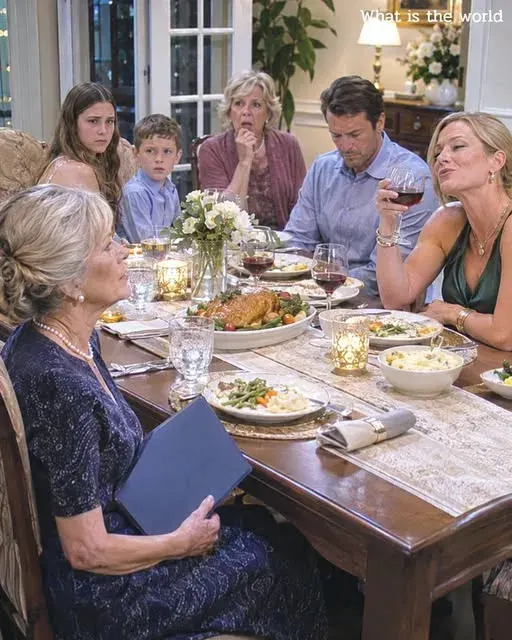
After Melinda dropped that envelope onto my plate, dinner ended the way a storm ends a picnic.
She gathered the children and herded them upstairs, ignoring Jackson's protests and Lily's frightened backward glances. Connor stood in the dining room for a long minute, looking from me to the photocopy to the empty doorway where his wife had gone, and then he followed her up the stairs without a word.
Ruth stayed. She washed the dishes while I sat at the kitchen table with the copy of my husband's supposed will in front of me under the overhead light.
It was one page. It was dated six weeks before Thomas died. It said, in plain typed language, that Thomas Arthur Hayes, being of sound mind, left his interest in the house at 2214 Grove Avenue to his son, Connor James Hayes, with his wife, Eleanor, to "retain a right to reside" there as long as she wished. At the bottom was a signature. Below that, a notary's stamp: Patricia A. Lowell, Notary Public, Commonwealth of Virginia.
"Ellie," Ruth said, drying her hands, "did Thomas ever say anything to you about changing his will?"
"Never."
"Would he have done it without telling you?"
I thought about it honestly, because it deserved an honest answer. Thomas was a gentle, private man. He did his own taxes and kept his own counsel. But we had owned the house jointly, together, with right of survivorship. Old Mr. Abernathy had told us that when we signed our wills in 2005. If one of us died, the house went to the other automatically, no matter what any will said.
"He couldn't have," I said slowly. "Even if he wanted to. The deed was joint. The house came to me the second he died."
Ruth sat down across from me. "Then why would she bother forging it?"
It was a good question, and I didn't sleep until I had an answer.
At eight the next morning, Harold called before I could call him. He had already seen it. Melinda's lawyer, a man named Gregory Pruett from a strip-mall firm in Chesterfield, had emailed him a copy at six-forty a.m. with a letter attached.
"She's not trying to claim the house through probate," Harold said. "She's smarter than that. Her lawyer is arguing that the will proves Thomas intended to sever the joint tenancy before he died, and that you, as a grieving widow, concealed it. He's asking the court to impose a constructive trust in Connor's favor." Harold exhaled heavily. "In plain English, Eleanor, they're saying you stole the house from your own son."
I sat down on the stairs in my bathrobe.
"And if they win?"
"Then your trust deed is worthless, because you can't put into trust something you were never entitled to. And the money she took on the credit line becomes, in their version, Connor's money borrowed against Connor's house."
"It's not real, Harold. Thomas never signed that."
"I believe you," he said. "But the signature looks real. Walt's already compared it to the copy of your old will in Abernathy's files. It's close. Very close. Whoever did this had his real handwriting in front of them."
I thought of Thomas's study. His rolltop desk. The cardboard boxes Melinda had carried to the attic three years ago when she turned the room into a playroom. Thirty years of his letters and birthday cards, his notes in the margins of books, his signature on everything.
"There's one more thing," Harold said, and his voice changed. "Pruett also filed a petition this morning with Adult Protective Services. He's claiming you've shown signs of cognitive decline and are making irrational financial decisions under undue influence. He's asking for an evaluation of your competency."
"Undue influence," I repeated. "From whom?"
"From me," Harold said grimly. "And from your sister."
Upstairs, I heard footsteps, suitcases rolling, doors banging. When I went up, the guest room and the children's rooms were half empty. Melinda had packed for the new house overnight. Jackson's posters were gone from the walls. Lily's purple beanbag chair was gone from the corner.
On the kitchen counter was a sticky note in Melinda's tidy, looping hand.
The children will be staying at Whitmore Court. Please don't contact them until this is resolved. —M.
I called Connor's cell phone eleven times that day.
He didn't pick up once.


