01 / 10
Chapter 1: The First Lie Under Oath
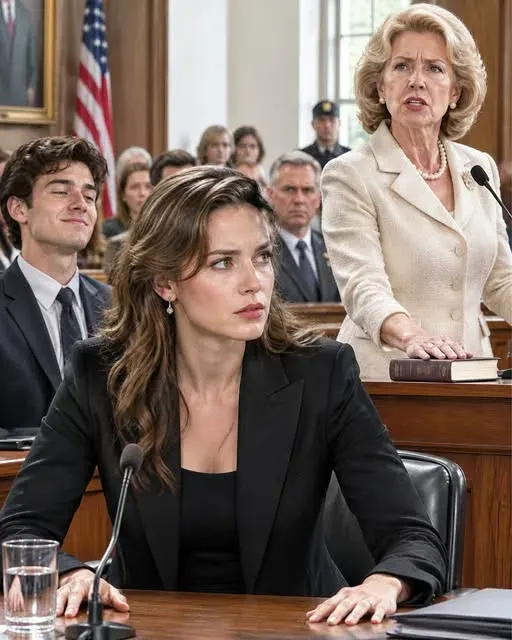
They called me a liar in a courtroom packed with spectators, and my own mother made sure every person there believed it. With one hand resting on the Bible, she looked the judge in the eye and said, "She was never a soldier. The scars, the medals, every bit of it was fabricated."
The first lie my mother told under oath erased twelve years of my life. The second one was designed to send me to prison.
My name is Rachel Wright. I was thirty-four years old, a retired Army captain, and that Tuesday morning I was sitting at the defense table in Courtroom 4B of the Norfolk Circuit Court in Virginia, charged with fraud, stolen valor, and forging federal records.
"She faked the scars," Elaine Wright repeated, softer this time, as if it hurt her to say it. "She bought the medals. She invented a war so her father would leave her his company."
A wave of whispers rolled across the gallery. Three rows of reporters bent over their notepads at once, and somebody near the back actually said, "Disgusting," loud enough for the bailiff to frown.
My mother never once looked at me. She looked at the jury. She looked at the cameras waiting in the hallway through the narrow glass panel of the door. She wore a cream skirt suit, her silver-blonde bob sprayed perfectly in place, and the pearl necklace my father had bought her for their thirtieth anniversary, eight months before the cancer took him.
She had practiced that face for weeks. A mother wounded by betrayal. Ashamed of her daughter. Brave enough to tell the truth anyway.
Across the aisle, in the front row of the gallery, my younger brother Curtis lowered his eyes and failed completely to hide the smile tugging at his mouth. He was twenty-nine, wearing a gray three-piece suit that cost more than my first car, and a gold Rolex that had belonged to our father.
I had taken that watch off Dad's wrist myself, in the hospice room, the night he died. Curtis had asked for it at the funeral lunch, in front of forty guests, and when I said Dad wanted it to go to the company's first employee, Curtis told everyone I was "already playing queen."
The watch never made it to that employee. I found out later Curtis had taken it from my glove compartment while I was crying at the grave.
What had started as a fight over Titan Tactical Systems, the defense company my father built from a two-bay garage in Chesapeake into a three-hundred-and-forty-million-dollar business, had grown into something far uglier. Dad left me fifty-one percent of the voting shares and named me executor of his estate. Three days after we buried him, Curtis walked into the lawyer's office with a different will. A newer one. Signed, witnessed, notarized, and leaving everything to him.
When I challenged it, Curtis didn't argue about the will.
He went after me.
He told the probate court I had never served a single day in the Army. He said I had spent six years "pretending to be deployed" while I was actually living off Dad's money in Europe. He said I had fooled a dying man with fake medals and fake scars so I could steal his life's work.
Then the Commonwealth's Attorney took an interest, and suddenly I wasn't a daughter fighting over an estate anymore. I was a defendant.
My attorney, Martin Feld, a quiet gray-haired man who had known my father for twenty years, leaned toward me and kept his voice under the murmur of the room. "Do not react."
"I won't," I said.
He stared at me for a second too long. My calm seemed to frighten him more than any outburst would have.
The prosecutor, a tall man named Gregory Haines, walked to the evidence table and lifted a black shadow box with both hands. Inside, against faded blue velvet, lay my Silver Star, my Purple Heart, and a scorched, blackened unit patch I had carried home from Kandar Province in the pocket of a flight suit that had to be cut off my body.
He held it up toward the witness stand. "Mrs. Wright, do you recognize these items?"
My mother looked at the box with practiced disgust, the way you look at something a dog brings in from the yard. "Yes. She keeps them on her mantel so guests will ask about them." She paused. "She bought those online."
Two jurors in the front row turned and stared at me as if I had walked into the courtroom wearing a dead soldier's name.
Beneath my white silk blouse, the old burn scar along my ribs seemed to tighten, the way it did on cold mornings.
And just like that, I wasn't in Norfolk anymore.
I was in the dust. The rotor wash was screaming. The aircraft was tilted on its side in a dry riverbed and the cabin was filling with smoke that tasted like melting plastic. Sergeant Tomas Reyes wasn't answering me. Warrant Officer Danny Kessler wasn't moving at all. And through the smoke came a pair of hands, a shoulder, a voice I would know for the rest of my life—Commander Duane Carney, dragging me across the gravel while rounds snapped into the fuselage behind us.
"Stay with me, Wright. You don't get to quit on my watch."
I opened my eyes. The courtroom came back.
None of it could be said out loud. The operation in Kandar was still classified. My service records were sealed under an order that had been renewed every two years since the crash. When Curtis built his attack, he built it on exactly that silence. He knew I couldn't produce my file. He knew I couldn't call a single member of my unit without breaking federal law.
Only my father had known the whole truth. In the last weeks, before the cancer took his voice, he had grabbed my wrist with a strength that surprised both of us and whispered things I didn't want to hear. That Mom and Curtis had been moving money through outside vendors. That some of those vendors didn't exist. That he'd found it too late to fix it himself.
"Protect the company, Rachel," he'd rasped. "But don't you dare burn your unit to do it. They saved my girl."
I promised him.
Now Curtis's attorney, a silver-haired man named Lyle Prescott who represented my brother's interests in the related civil case and had been allowed to sit at the prosecution's elbow, rose from his seat. The judge let him ask a few clarifying questions. "Mrs. Wright," he said gently, "did your daughter ever deploy overseas?"
"No."
"Did she ever serve in the United States Army, in any capacity?"
"No." Her voice cracked on cue. "I wish to God she had. Then at least she'd have learned some honor."
The judge, the Honorable Patricia Okafor, looked at me over her reading glasses for a long moment. I knew what she saw. A woman with no records, no witnesses, and a mother on the stand calling her a fraud.
Then Haines delivered the blow he had been saving.
"Your Honor, the Commonwealth would also like to enter Exhibit 31." He handed a document to the clerk. "A letter from the National Personnel Records Center stating that no service record exists for a Rachel Ann Wright, born in Norfolk, Virginia, matching the defendant's date of birth."
The room exploded. Reporters were half out of their seats. Curtis finally lifted his head and looked straight at me, and he didn't bother hiding the smile anymore.
I knew why that letter said what it said. Sealed records don't exist, officially. But to that jury, it was proof.
Martin's hand closed on my forearm under the table. "Rachel," he whispered, and his voice was shaking now. "If you have anything—anything—now is the time."
The courtroom doors stayed shut.
Finally, my mother turned her head and looked at me.
A small smile appeared on her face. Private. Cruel. Victorious. It was the same smile she'd worn when I was eleven and she told my father I'd broken her crystal vase, when she was the one who'd knocked it over. The same smile she'd worn when I left for basic training and she told her bridge club I'd "run off with some boy."
I placed both hands flat on the defense table and looked up at the clock above the judge's bench.
11:47.
Thirteen minutes until the authorization expired. Thirteen minutes until the truth was finally allowed to walk through those doors—or never at all.
At 11:52, the judge asked whether the defense had any objection to the exhibit. Martin stood, sat, stood again. At 11:55, Haines began reading the letter aloud to the jury, savoring every word.
At 11:58, the heavy oak doors at the back of Courtroom 4B swung open.
Every head turned.
A tall man in a dark green Army dress uniform walked down the center aisle, his gray hair cut close to the scalp, a pale scar slicing through his left eyebrow, and four rows of ribbons on his chest. Behind him came a woman in a JAG Corps uniform carrying a locked leather case, and behind her, a man in a dark suit with a Department of Defense badge clipped to his belt.
The courtroom went so quiet I could hear the ventilation humming.
I watched my mother's face.
The smile didn't fade. It collapsed. Her hand slid off the Bible. The color drained from her cheeks so fast that the bailiff took a half step toward the witness stand, thinking she might faint.
Because my mother knew that man.
Commander Duane Carney stopped in front of the bench, came to attention, and handed the JAG officer's sealed order to the clerk. Then he turned his head slowly, deliberately, and looked straight at the witness stand.
"Mrs. Wright," he said, in the voice that had pulled me out of the smoke twelve years earlier. "You remember me. Landstuhl Regional Medical Center. Germany. You signed for your daughter's Purple Heart while she was still in surgery."
Someone in the gallery gasped. My mother opened her mouth, and nothing came out.
Carney wasn't finished.
"And I'm also here," he said, turning toward the gallery until his eyes landed on my brother, "about a company called Halvorsen Supply. Because the part that brought down my aircraft in Kandar was sold to the Army by a vendor of Titan Tactical Systems."
Curtis's Rolex hit the floor of the gallery with a sharp metallic crack.
He didn't even bend down to pick it up.


