02 / 10
Chapter 2: Thirteen Minutes
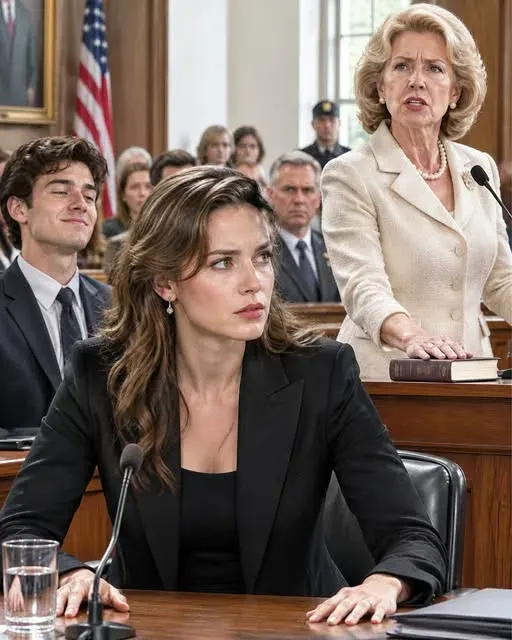
Judge Okafor cleared the courtroom in under four minutes.
The reporters were herded into the hallway, still shouting questions through the doors. The jury was sent to the deliberation room with strict instructions not to discuss anything they had seen. My mother was escorted down from the witness stand by a bailiff who no longer looked at her with sympathy, and Curtis was told to remain seated in the empty gallery, his gold watch still lying face down on the floor beside his polished shoes.
Then the judge called counsel into chambers. Martin looked at me, and the JAG officer—a compact, sharp-eyed woman who introduced herself as Lieutenant Colonel Dana Whitfield—said, "The defendant comes too. The order covers her."
Judge Okafor's chambers smelled like old paper and burnt coffee. She sat behind a desk covered in case files and read the order twice before she said anything.
"This is a limited declassification authorization," she said finally, "signed by the Assistant Secretary of the Army, permitting sworn testimony regarding Captain Rachel Wright's service, injuries, and decorations, in a closed session, before this court only. Expiring at noon today." She looked up at the clock. It was 12:03. "Colonel, it seems you're three minutes late."
"No, ma'am," Whitfield said, and pointed to a line near the bottom. "Expiring at noon on the date of first presentation. We presented at 11:58. The clock started when the commander handed it to your clerk."
The judge's mouth twitched. It was the first time anyone in that building had looked at me as anything other than a criminal.
"Then let's hear it," she said.
Commander Carney testified for forty-one minutes.
He described the night of March 9th, twelve years earlier, when a medevac helicopter carrying a wounded interpreter went down in a dry riverbed in Kandar Province. He described First Lieutenant Rachel Wright, twenty-two years old and four months into her first deployment, serving as the flight's liaison officer. He described how the tail rotor failed without warning at two hundred feet, how the aircraft rolled, and how I had crawled back into the burning cabin twice to pull the interpreter, a nineteen-year-old named Farid, out through the cargo door.
"She went back a third time for Sergeant Reyes," Carney said, staring at a spot on the wall. "That's when the fuel line went. I pulled her out by her vest. Reyes and Warrant Officer Kessler didn't make it. Farid did. He's an American citizen now. He teaches high school chemistry in Ohio."
Lyle Prescott cleared his throat. "Commander, with respect, this is a very moving story. But how do we know the woman you're describing is the defendant?"
Carney didn't answer him. He reached into the leather case, removed a photograph, and laid it on the judge's desk.
It showed a hospital room at Landstuhl. A young woman lay in the bed with gauze wrapped from her collarbone to her waist and an oxygen tube under her nose. A general was pinning a Purple Heart to her pillow. And standing at the foot of the bed, holding a clipboard, wearing a camel coat and pearl earrings, was Elaine Wright.
"Her mother flew out on day six," Carney said. "Stayed two nights. Complained about the food and the hotel. Signed the receipt for the medal because her daughter couldn't hold a pen." He placed a second sheet on the desk—a photocopy of a military property receipt with my mother's looping signature at the bottom. "That's her handwriting. I'd bet my pension your probate court has a dozen samples to compare it to."
Haines, the prosecutor, sat down very slowly.
"There's more," Whitfield said quietly, and slid a thin file across the desk. "The crash investigation was classified because of the mission. But the mechanical findings were not. The tail rotor failed because of a counterfeit bearing housing. It was traced to a supplier called Halvorsen Supply, LLC, of Virginia Beach. Halvorsen was a sub-vendor on a parts contract held by Titan Tactical Systems."
Martin turned to look at me. "Rachel. Did you know?"
"I knew the name," I said. My voice sounded strange in my own ears. "My father said it to me two weeks before he died. He said, 'Find out who owns Halvorsen.' I've been trying for four months. Every door is locked."
Judge Okafor took off her glasses and pressed her fingers to the bridge of her nose. When she spoke again, her voice was flat and cold, and it wasn't aimed at me.
"Mr. Haines, I am going to give the Commonwealth until two o'clock to decide whether it wishes to continue prosecuting a decorated combat veteran on the word of a witness who appears to have perjured herself in my courtroom. I would think very carefully about that decision."
At 1:47, the Commonwealth's Attorney moved to dismiss all charges with prejudice.
When we walked back into Courtroom 4B, it was nearly empty. My mother sat on a bench near the back, her pearls clutched in one fist, her lawyer whispering urgently in her ear. Curtis was gone. Someone had picked up the Rolex.
Judge Okafor read the dismissal into the record. Then she looked at me over her glasses.
"Captain Wright," she said. "On behalf of this court, I apologize for what you were put through in this room."
I stood. My knees didn't feel like mine.
"Thank you, Your Honor."
"And Mrs. Wright." The judge didn't raise her voice. She didn't have to. "I am referring the transcript of your testimony to the Commonwealth's Attorney for review of perjury charges. Do not leave the state."
My mother's lawyer put a hand on her shoulder. She shrugged it off and stood, and for the first time since the trial began, she walked straight toward me.
She stopped two feet away and lowered her voice so only I could hear.
"You think this is over because some soldier showed up with a photograph?" she said. "You have no idea what you've just started. Your father isn't here to protect you anymore."
"He never had to protect me from you, Mom," I said. "He just never believed he'd need to."
Outside on the courthouse steps, Commander Carney stood beside me while the cameras flashed. He didn't say a word to the press. When the last reporter gave up, he took off his cover and turned it in his hands.
"Your father called me," he said. "Three weeks before he passed. Said if anything ever happened to you, I should look at Halvorsen. I've spent four months getting that authorization through the Pentagon."
"Why didn't you tell me?"
"Because if you'd known I was coming, you'd have stopped fighting your own battle and waited for me." He almost smiled. "And you never did that once in your life, Wright."
Then his face went serious again.
"Your mother wasn't frightened of me in there," he said. "She was frightened of what I know. Find out who owns Halvorsen Supply, Rachel. Because I think you already suspect."