04 / 10
Chapter 4: My Father's Last Words
I sat in that parking garage for an hour, staring at my mother's maiden name on the screen.
Then I drove to the only place I could think of: my father's old office on the third floor of Titan's headquarters on Military Highway. Since his death, nobody had touched it. His reading glasses were still folded on the blotter. His Navy coffee mug still had a ring of dried coffee at the bottom.
I locked the door and sat in his chair, and I let myself remember the last month.
The cancer started in his pancreas and spread fast. By the time the doctors found it, they gave him four months. He used them like a man running out of daylight with a job still unfinished. He came to the office every morning until he couldn't stand, and then he had his files brought to the hospice room at Sentara.
Two weeks before he died, he sent the nurse out and asked me to close the door.
"Your mother and your brother," he said, and stopped to breathe. "They've been running money through vendors. Outside companies. Padding contracts. Some of those vendors—Rachel, I don't think they exist."
"How much?"
"I found eleven million over six years. Could be more." His hand found mine on the blanket. "I should have seen it. I was so proud of Curtis for finally taking an interest in the business. I signed whatever he put in front of me."
"Dad, we have to go to the authorities."
"Not yet." He gripped harder. "Some of those contracts are Army. If this goes public the wrong way, the auditors will tear into every program Titan ever touched. Including the one your unit flew. Your files will come out in discovery, Rachel. Your people. Carney. Farid's family. The ones still serving."
"Then what do I do?"
"Get control first. I've changed my will. You get fifty-one percent and the executor's seat. Martin Feld has the original in his safe." He coughed for a long time, and when he stopped, his eyes were wet. "Find out who owns Halvorsen. Protect the company. And don't you dare burn your unit to do it. They saved my girl when I couldn't."
That was the last clear conversation we ever had. After that it was morphine and broken sentences and, once, at three in the morning, my name.
He died on a Thursday. We buried him on Sunday at the Wright family plot in Forest Lawn, with an honor guard from Naval Station Norfolk folding the flag. My mother accepted it with dry eyes and a black hat with a veil. Curtis gave a eulogy that made half the church cry. He talked about fishing trips that never happened.
On Wednesday, Martin Feld called me into his office to read the will. My mother and Curtis were already sitting there, and Curtis was holding a manila envelope.
"Before we begin," he said, "you should know there's a more recent will."
He slid it across the desk. It was dated nine days before Dad's death. It left all of Dad's Titan shares to Curtis, named Curtis executor, and left me "my personal effects from the family home, in recognition of her choices." It was signed in a shaky hand, witnessed by a man named Brent Talley and a hospice volunteer named Gloria Simms, and stamped by a notary named Kevin Marsh.
"Dad was barely conscious nine days before he died," I said.
"He had good days," my mother said, folding her hands in her lap. "You weren't always there, Rachel. I was."
That was a lie. I had slept in that chair for three weeks. She had visited twice, both times for under an hour, and both times on her way to lunch at the Harbor Club.
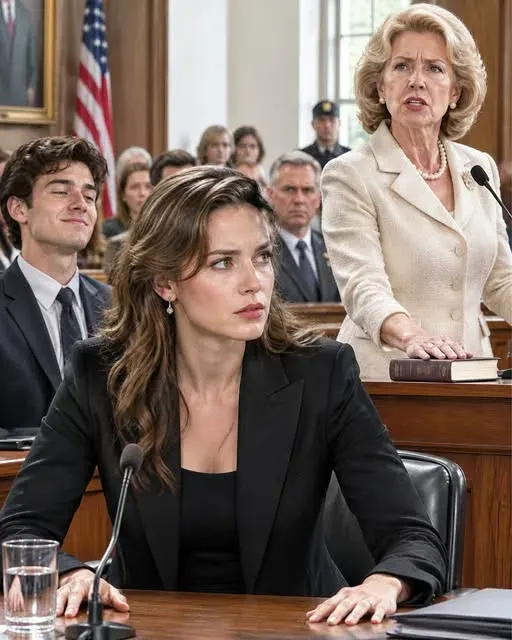
When I filed my challenge, Curtis's lawyers didn't argue about the signature. They filed a counterclaim saying I had manipulated a dying man with a fabricated military career, and that I had no moral right to anything he left. Two weeks later, the Commonwealth's Attorney opened a criminal investigation, prompted by "a sworn complaint from a family member."
My mother.
Now, sitting in Dad's chair, I opened his bottom desk drawer, where he always kept the things he didn't want anyone to find—his Navy discharge papers, my baby teeth in a tin, a stack of my letters from Afghanistan. Under the letters, taped to the bottom of the drawer, was a small brass key and a yellow sticky note in his blocky handwriting.
"Rach. Bay 6. Behind the old lathe. Love, Dad."
Bay 6 was the original garage in Chesapeake. Titan still owned the building. It stored scrap and old machines nobody used.
I was in my car before I'd finished reading it twice.


