02 / 10
Chapter 2: Letters From Seattle
I sat down right there on the closet carpet, my back against Mitchell's row of pressed khakis, and read until the sunlight through the bedroom window faded from gold to the flat gray of late afternoon.
There were birthday cards for every year I had missed—twenty-five, twenty-six, twenty-seven, all the way to thirty-one—each one signed in two different hands. There were Christmas cards with photographs tucked inside them: a brand-new warehouse with Halloran Freight and Logistics painted in green letters above its loading doors, Brendan grinning in a tuxedo beside a laughing redhead, and a baby girl in a knitted pink hat.
On the back of the baby picture, Brendan had written, "Meet your niece. We call her Mo, and she has your stubborn chin."
Every return address was the same street in Seattle, a city I had never visited, nearly three thousand miles from the Columbus church where the three of us had last stood together.
"I don't care what you said in that church basement," Brendan wrote in one card, his big looping letters crowding the edges. "You're still my little sister, and nothing you say will ever change that."
Shane's letters were shorter, printed in the cramped capitals he had used on shipping manifests since he was nineteen. In one, he told me the company finally had forty trucks and a contract on the Seattle docks, and that he would sell every one of those trucks for five minutes of hearing me laugh.
I noticed something else as I read. A few of the Christmas letters still carried the faint rusty dent of a paper clip in one corner, as if something had been fastened there once and removed.
At the very bottom of the box lay a printed phone bill from four years earlier. A dozen calls from a Seattle area code were highlighted in yellow, and beside them, in the tidy block printing Mitchell used on his classroom whiteboard, was one word: blocked.
I stared at that word until it stopped looking like English. For seven years, I had told anyone who asked that my brothers had walked away from me, and all that time, they had been knocking on a door my husband had locked from the inside.
My hands were trembling so badly that it took me three tries to call him. Mitchell answered on the fourth ring, using the warm, easy voice he saved for pastors and parents. "Hey, babe, I'm still stuck in this booster meeting—"
"Why are my brothers' letters hidden in your closet?"
The line went so silent that I could hear a vending machine humming somewhere in the high school gym. When Mitchell spoke again, every ounce of warmth had drained out of him.
"Those two only ever wanted your money," he said evenly. "I handled it, the way I handle everything around here, so don't do anything stupid before I get home."
Then he hung up, and I sat in the closet with the dead phone against my ear, surrounded by seven years of my brothers' handwriting.
I couldn't unsay a single word of what I had told them in that church basement. What I could do was stop letting Mitchell answer for me.
Our phones were on a family plan that Mitchell managed, and it took me four minutes in the carrier's app to find the blocked list. There were exactly two numbers on it, both with a Seattle area code, and I deleted them with a thumb that nearly missed the button.
I still had Brendan's old number saved under a single letter B, because I had never quite found the courage to erase it.
"It's Ray," I typed. "I found your letters, and I was wrong about everything—I am so, so sorry, and I need you to call me."
After I hit send, I dragged my black suitcase down from the closet shelf and started packing.
My phone rang before I had folded my second sweater. I answered, and neither of us said a word—I just listened to my brother breathing on the other end of the line.
"Ray?" Brendan finally said, carefully, like a man afraid the call would vanish if he spoke too loudly.
Then he pulled away from the phone and shouted to someone beside him, "Shane, it's her—it's really her!"
The strangest part came next. They weren't in Seattle at all; they were in Ohio for the grand opening of Halloran Freight's first Midwest hub, a warehouse in Dayton, and when I gave him my address, Brendan said they could be at my door in forty minutes.
"Don't hang up," he begged. "Please, Ray—not this time, not on us."
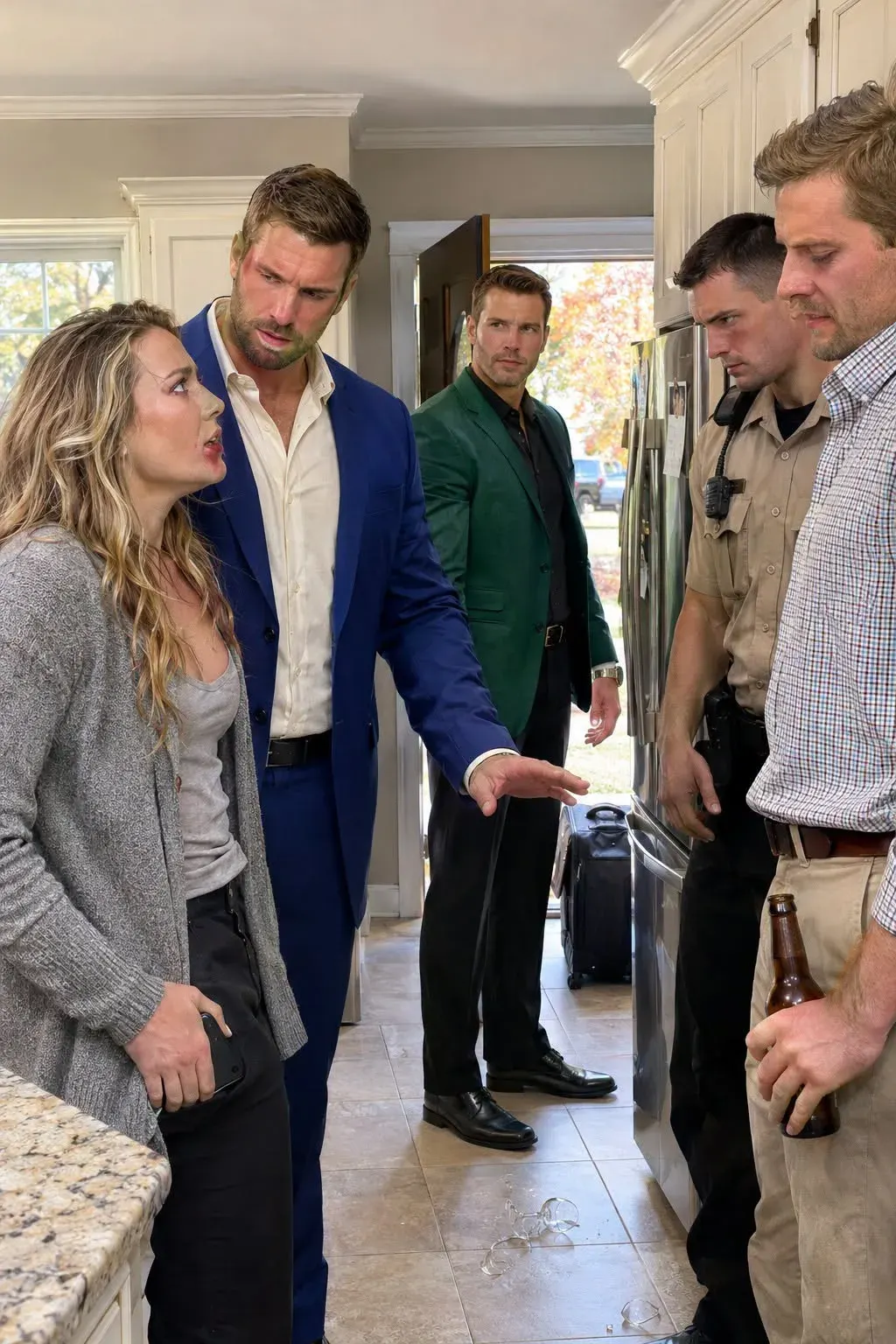
I put the call on speaker and tucked the phone into the front pocket of my gray cardigan, because my hands were too unsteady to hold it and pack at the same time. Shane's voice came through, lower and rougher than I remembered, and Brendan still laughed at the end of half his sentences.
I hauled the suitcase downstairs, set it beside the front door, and went into the kitchen to take the last photograph of my mother off the refrigerator. I had just slid it free from its magnet when the garage door rattled open behind me.
Mitchell had said the meeting would run another hour, but he had made it home in fifteen minutes. He came through the door from the garage in his checked shirt and khakis, his keys still in his hand, and right behind him, in his tan uniform with the radio clipped to his shoulder, came Brock.
Mitchell's eyes went straight to the black suitcase by the front door, and the friendly face he wore at school simply disappeared.
He hadn't come home to talk. He had brought a deputy with him.