01 / 10
Chapter 1: The Black Briefcase
Eleven minutes after a doctor told Serena Gallagher Costello she had leukemia, I slid a silver pen across a marble desk and offered her fifty thousand dollars to disappear from her husband's life. I thought I was the only person in that room who knew she owned almost everything he had—because I was the lawyer who had hidden her name underneath it.
Dangerous men rarely read what they sign, and I had drafted documents for them for thirty-one years. Jonathan Pierce, attorney at law, fifty-six—and for twenty-four of those years, my most important client was Declan Gallagher, who ran the South Side of Chicago from the back booth of a Beverly tavern and was the only one who read every word I wrote him, twice.
When Declan died two summers ago, his son-in-law absorbed what was left of his organization, his men, and his lawyer. Nathaniel Costello was forty, handsome the way an expensive knife is handsome, and as far as I knew, he had never read past the first page of anything in his life.
Three weeks before that gray Tuesday in March, Nathaniel had called me into his River North office and told me to draft divorce papers. "Keep them in your car," he said, without looking up from his phone. "I'll tell you when."
I didn't ask why. In my profession, the men who ask why don't last thirty-one years.
That Tuesday, he told me to wait in the lobby of the Calloway Cancer Pavilion while he rode upstairs with his wife to hear her test results. He had brought his divorce lawyer to her cancer appointment the way another man might bring an umbrella on a cloudy day.
At 2:19, my phone buzzed with two words. Top floor.
On the ride up, I caught my reflection in the brass elevator doors—silver hair combed, rimless glasses, charcoal suit, gray tie—a respectable man carrying a briefcase full of cruelty. Nathaniel met me upstairs in his navy suit, dark hair slicked back, checking his silver watch, and at 2:25, I followed him into Dr. Harrison Caldwell's private office.
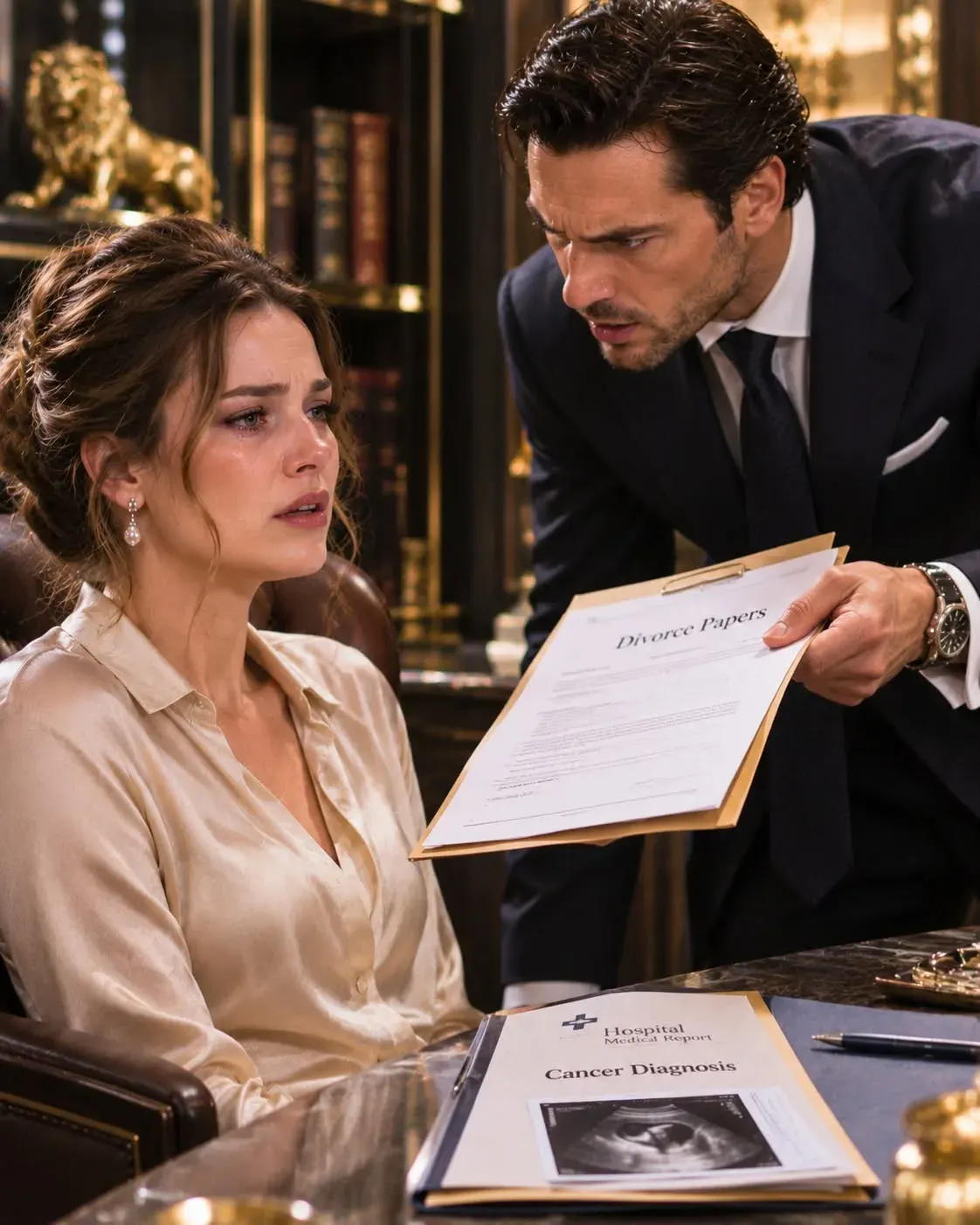
It looked more like a gentleman's library than a place where people heard terrible news—dark wood bookshelves crowded with leather-bound volumes, a small gold lion gleaming on the middle shelf, and brass lamps casting warm light over a polished dark marble desk. On the desk lay a hospital folder labeled Cancer Diagnosis, a printed scan clipped to its cover and a silver pen beside it.
Serena was thirty-two, and she sat in a brown leather armchair in a champagne silk blouse, her chestnut hair slipping loose from its updo, pearl drops trembling at her ears. Her hazel eyes were red, her cheeks flushed and wet, and she was staring at the door as if she had been waiting for it to open since the moment her husband walked out, which she had.
Nathaniel took the divorce papers from my hands, squared them against a manila folder, and bent over his wife's chair. He didn't sit and he didn't touch her; he simply held the pages out in front of her, the way a man holds out a bill.
Serena looked at the papers, then up at him, her voice cracking. "You're leaving me? Today?"
"I need a partner, not a medical crisis," Nathaniel said flatly.
Dr. Caldwell's head snapped up. "Mr. Costello, this is a medical consultation—"
"And this is my marriage," Nathaniel said, without turning his head.
Then he glanced at me, and I did what I had been paid to do for thirty-one years. I stepped up beside the marble desk with my black briefcase open in one hand and slid the silver pen toward his wife.
"The proposed settlement is fifty thousand dollars."
I had chosen that word in the car downstairs. Proposed—an offer, not a fact, something a woman with a good lawyer could refuse—and I added that she should have independent counsel look it over, the way you'd point out a fire exit to someone who might need one.
Through her tears, Serena's eyes narrowed on that single word. "Proposed?"
Nathaniel shot me a look sharp enough to cut glass. I looked away and adjusted my glasses, which is what I do when nothing safe is left to say.
"I'm not discussing this," Nathaniel said, turning back to her. "You have forty-eight hours to leave the penthouse."
Something changed in Serena's face then. The tears were still there, but behind them, something harder was surfacing, like the riverbed when the water drops.
She lifted her chin, set two fingers on the silver pen, and pushed it back across the marble until it touched my hand. "You remembered the prenup," she said, her voice low and steady. "You forgot the deeds."
For three full seconds, no one in the room breathed. Then Nathaniel straightened, frowning the way he did when a waiter brought him the wrong wine.
"What deeds?" he asked.
Serena didn't answer him. She looked at me instead—a long, level look that told me she knew exactly who had drafted them.
Nathaniel tossed the papers onto the marble and walked out, snapping his fingers for me to follow. As the door swung shut, I heard Dr. Caldwell close the folder and say her name the way you'd wrap a blanket around someone pulled from a cold lake.
In the elevator, Nathaniel waited until the doors slid shut, then gripped my arm above the elbow hard enough to bruise. "What deeds, Jonathan?"
For two years, I had answered every question that man asked me within the hour. That afternoon, with the floor numbers ticking down and his fingers digging into my sleeve, I told him I would have to check the files.
It was a lie. The answer was locked in my office safe, in a blue folder, directly above his own signature.