01 / 10
Chapter 1: She Bought Those Online
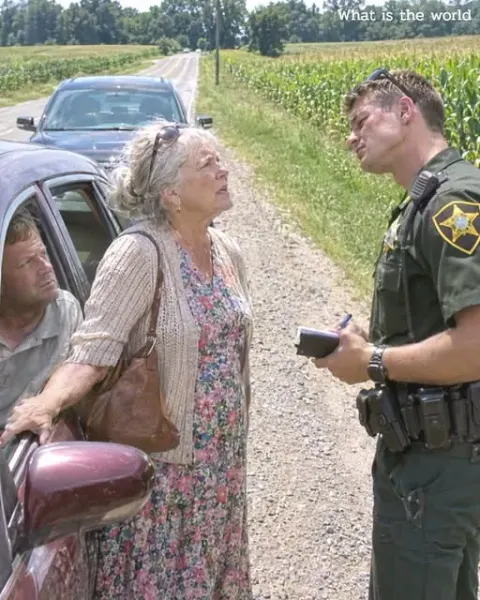
My own mother looked a federal judge in the eye and swore I had never served a single day in the Army. She called my scars fake. She said my medals were bought online. And I sat at the defense table with my hands folded and said nothing, because the only proof that could save me was locked inside classified files I had sworn an oath never to speak about. Not until 12:00 p.m.
My name is Mara Bennett. I am thirty-eight years old, and for twelve years I served in the United States Army. I have learned that the hardest lessons do not come from your enemies. They come from the family who watched you bleed, and then stood up in a courtroom and called it a performance.
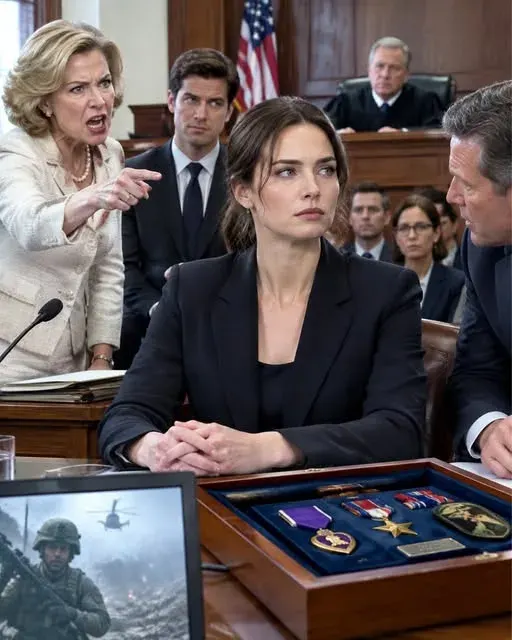
"She was never in the Army," my mother, Linda Bennett, told the jury in Courtroom 700 of the federal courthouse in Alexandria, Virginia. She wore a pale pink suit and the pearl necklace my father gave her on their thirtieth anniversary. "The scars, the medals, the whole story. She invented every bit of it. She's been lying since she was a little girl."
The whispers came fast. Reporters in the gallery scribbled every syllable. Two jurors in the front row looked at me like I was something stuck to the bottom of their shoes.
Across the aisle, in the first row behind the prosecutor's table, my younger brother Caleb sat in a charcoal Tom Ford suit, pretending to study the floor. But I could see the corner of his mouth. He was smiling.
My attorney, Nathan Price, leaned close to me. "Mara," he murmured, "don't react."
"I won't."
He looked at me a moment too long. "That's what worries me."
This war had started eight months earlier, with my father's company. Robert Bennett founded Bennett Meridian Systems in his garage in Fairfax in 1989 and built it into a defense electronics firm with nine hundred employees and contracts with the Navy and the Air Force. When he died of pancreatic cancer in March, his will left me fifty-one percent of the company's voting shares and named me executor of his estate.
Three days after the funeral, Caleb walked into the lawyer's office with a different will. A "new" one, dated six weeks before Dad died, leaving Caleb everything. It was witnessed by our mother.
So I challenged it in probate court.
And Caleb changed the battlefield.
He went to federal prosecutors with a story. He claimed I had never served in the military. He said I had forged my discharge papers, invented twelve years of service, and manipulated our dying father with stolen valor to steal his company. When investigators searched the federal databases for my service record, they found almost nothing. A few lines. An enlistment date. And then a blank wall.
Because my records were sealed. Because for six of my twelve years, I served in a unit whose name I am still not allowed to say.
Before long, the United States Attorney's office charged me with fraud, forgery, and falsifying federal documents. If I was convicted, I faced up to fifteen years in prison. And with a felony conviction, my father's will would mean nothing. Caleb would inherit it all.
Now the prosecutor, a sharp woman named Andrea Lowell, walked to the evidence table and picked up a polished walnut display case. She opened it slowly in front of the jury.
Inside lay my Silver Star. My Purple Heart. And a scorched, blackened unit patch, its embroidery half burned away.
"Mrs. Bennett," Lowell said, "have you seen these items before?"
My mother glanced at the case, then at me. "She bought those online," she said. "You can get anything on the internet these days. Caleb showed me the websites."
A juror in the second row shook her head in disgust. I heard the words without anyone saying them. Fraud. Liar. Imposter.
Under my white silk blouse, the long ridged scar along my left ribs began to throb.
And suddenly I wasn't in that courtroom anymore. I was back in the smoke, the helicopter spinning, rotor blades screaming, the world tilting sideways. Gunfire ripping through the dark. Blood soaking through my uniform, hot and then cold. And Major Daniel Hayes, a giant of a man with a Georgia accent, dragging me by my vest through burning wreckage while the night came apart behind us.
"Stay with me, Bennett. You don't get to quit on me tonight."
I lived. I carried the proof on my body.
But I couldn't say a word.
Caleb knew exactly what he was doing. He had built his whole case on the one truth I was bound by oath to hide.
My father had understood. A week before he died, he gripped my hand in his hospital bed at Inova Fairfax, his voice barely a whisper. "They're moving money through shell companies, Mara. Protect the company. But don't expose your unit. Promise me."
I gave him my word. And I kept it.
Now my father's longtime attorney, Harold Kessler, a white-haired man of seventy-two who had joined my defense team without charging a dime, rose to cross-examine my mother.
"Mrs. Bennett," he said gently. "Did your daughter ever deploy overseas?"
"No."
"Did she ever serve in the United States Army?"
"Never." My mother looked right at me and smiled. It was a victorious smile. She thought my oath would trap me forever.
"Then where," Kessler asked, "do you believe she was for twelve years?"
"Working at some consulting firm in Tampa, I suppose. She never told us anything. She sent a few letters. I didn't bother reading them."
That one landed somewhere deep. I kept my face perfectly still.
I folded my hands on the table and looked up at the large round clock above the jury box.
11:47 a.m.
My heartbeat didn't change. Twelve years of training does that.
Nathan watched me. "What are you waiting for?" he whispered.
"Authorization."
"For what?"
I kept my eyes on the second hand. "In thirteen minutes," I said, "classified becomes declassified."
He stared at me. Across the aisle, Caleb leaned back in his chair and laced his fingers behind his head like a man watching his horse cross the finish line.
The prosecutor wrapped up. Judge Margaret Ellison, a stern woman with steel-gray hair, glanced at the clock. "We'll break for lunch at noon," she said. "Mr. Kessler, any further questions for this witness?"
"Just a few, Your Honor."
11:58. 11:59.
At exactly 12:00 p.m., the heavy oak doors at the back of Courtroom 700 rattled.
Every head turned.
The doors swung open, and a tall, broad-shouldered man in an Army dress blue uniform walked down the center aisle. Silver eagles on his shoulders. A chest full of ribbons. A long, pale scar running from his left ear down his neck into his collar.
Colonel Daniel Hayes.
Beside him walked a woman in uniform carrying a sealed leather document case, the gold crossed pen and sword insignia of the Judge Advocate General's Corps on her lapel.
My mother's smile slid off her face.
"Your Honor," Colonel Hayes said in a voice that filled the room, "I apologize for the interruption. I am Colonel Daniel Hayes, United States Army. As of twelve o'clock noon Eastern time, the Secretary of the Army has declassified the service records of Captain Mara Bennett, who served under my command for six years. I have them here." He turned and looked straight at my mother. "Captain Bennett has never lied to this court. She simply wasn't permitted to tell it the truth."
The courtroom erupted. Judge Ellison banged her gavel three times.
Caleb had gone white. He was half out of his chair.
Then Colonel Hayes said something I hadn't expected at all.
"And Your Honor, I'm afraid that's not the only reason I'm here."
He stepped aside. Behind him, two men in dark suits with FBI credentials on their belts walked through the open doors. They didn't look at me.
They looked at my brother.