05 / 10
Chapter 5: Silence Is A Weapon
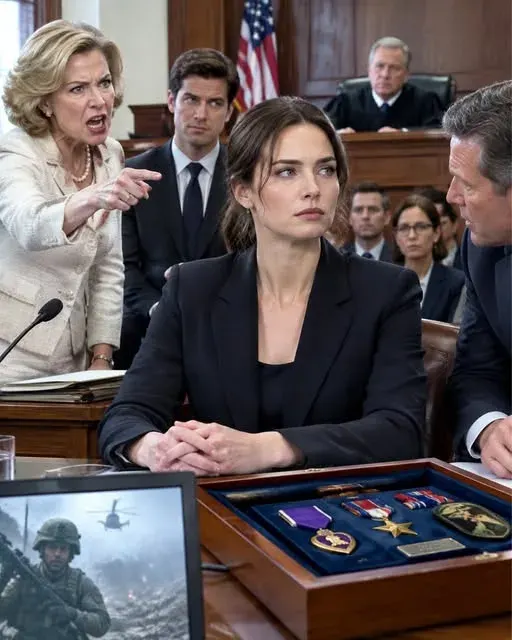
The trial began in October. By then I had lost my job, half my friends, and nearly every dollar in my savings account.
The prosecution's case was simple and devastating. Andrea Lowell called a records specialist from the National Personnel Records Center in St. Louis, who testified that my official service file contained only a single enlistment entry and "no verifiable record of commissioned service, deployment, or awards."
She called a document examiner, who testified that my discharge papers contained "formatting irregularities inconsistent with standard Army forms." He was right. Special unit discharge papers are different. I couldn't say why.
She called the jeweler in Richmond who had appraised my Silver Star at Caleb's request and declared it "consistent with commercially available replicas," because he had never held a real one.
And every day, I sat at the defense table in silence while Nathan Price grew more and more desperate.
"Mara, I can't defend you if you won't tell me anything," he said one night in his office, pacing in front of the window. "Give me one name. One base. One person who can vouch for you."
"I can't."
"You're going to prison for fifteen years to protect a secret?"
"I'm going to keep my word," I said. "That's all I have left of him."
Harold Kessler was the only one who seemed to understand. He'd known my father for forty years. One evening, he put a hand on my shoulder and said, "Robert told me once that you were the bravest person he'd ever met. I didn't understand what he meant until this trial."
Outside the courthouse every evening, the reporters were waiting. "Ms. Bennett, did you ever serve?" "Ms. Bennett, where did you buy the Silver Star?" One afternoon, a man in a VFW cap spat on the sidewalk in front of my shoes and called me a disgrace to everyone who'd ever worn the uniform.
I didn't answer him. I just kept walking to Nathan's car. That night, I sat in my condo with the lights off and held the burned unit patch in my hands until dawn. It still smelled faintly of smoke if I held it close enough. Or maybe I only imagined that.
The next morning, there was a small envelope tucked under my door. No stamp. Inside was a single index card in block letters.
"HOLD THE LINE, BENNETT. ALMOST THERE. —D.H."
I put it in my jacket pocket, over my heart, and wore it to court every day after that.
On the eighth day, Caleb took the stand. He was smooth and grieving and utterly convincing. He told the jury how I'd come home "with a new story every year," how I'd "preyed on Dad's patriotism," how heartbroken he was to have to testify against his own sister.
"I love her," he said, his voice breaking perfectly. "But someone has to protect what Dad built."
Then, on the ninth day, they called my mother.
The night before, I had driven to the house in McLean for the first time since the funeral. I sat in my car at the bottom of the driveway for twenty minutes before I knocked on the door. My mother opened it in her bathrobe.
"Mom, please," I said. "You saw my scar. You visited me at Walter Reed after the crash. You held my hand."
Her face did something strange then. For one moment, I saw something crack behind her eyes. Then she closed the door in my face without a word.
The next morning, she walked into Courtroom 700 in her pale pink suit and swore I had never served.
Then, at exactly 11:41 a.m., my phone buzzed silently in my jacket pocket under the table. I glanced down. A single text from Agent Ruiz.
"Signed. Effective 12:00. We're outside."
That was when I folded my hands and started watching the clock.


