01 / 10
Chapter 1: No Money, No Lunch
For nine years, I quietly paid off hungry children's lunch debts out of my own paycheck. Six thousand eight hundred dollars, five and ten and twenty at a time. Then the new principal caught me. He took a hot lunch tray out of a seven-year-old's hands, dumped it in the trash in front of the whole cafeteria, and told me I was fired.
Two hours later, that little boy collapsed on the playground.
My name is Dacey Kowalski. I'm sixty-one years old, and for twenty-two years I worked in the cafeteria at Lincoln Elementary School on the east side of Toledo, Ohio, in a brick building with a cracked blacktop playground and a mural of Tony Packo's hot dogs that the third graders painted in 2009.
I served breakfast and lunch to almost five hundred children a day. I knew every one of them by name. I knew who wanted extra ketchup and who hated peas and who would only eat the corn if it didn't touch the chicken. I knew whose parents were getting divorced, whose grandma was sick, whose big brother had just gone to jail.
And I knew which kids were hungry.
Not "I skipped a snack" hungry. Really hungry. The kind of hungry where a child eats a school breakfast so fast he gets the hiccups, then asks if there's any extra, then puts the extra in his pocket for later. The kind of hungry where Monday morning is the worst day of the week, because the weekend had no school lunch at all.
At our school, when a family couldn't pay for lunch, the cost went onto the child's account as debt. Sometimes it was two dollars. Sometimes it was two hundred.
For a long time, the rule was simple. Every child gets a hot lunch, debt or no debt. We'd send a letter home and that was that.
But nine years ago, the district changed the rules to save money. If a child's lunch debt went over ten dollars, they got what the memo called a "cold alternative." A plain cheese sandwich on white bread in a plastic bag. No milk. No fruit. Nothing hot. Nothing else.
The kids with the cheese sandwiches started sitting together in the corner by the trash cans. Nobody told them to. They just did. And every child in that cafeteria knew exactly why.
I couldn't stand it.
So I started paying.
Five dollars here. Twenty dollars there. Every Friday afternoon, after the last trays were washed, I'd sit down at the register in my hairnet, pull up the accounts with the biggest balances, and pay them down out of my own debit card. I kept a little spiral notebook in my purse. I never told anyone. Not the children, not the parents, not the principal, not even my own daughter.
In nine years, I paid six thousand eight hundred dollars.
I'm not rich. I drive a 2004 Buick LeSabre with a coat hanger holding up the muffler. My husband, Walt, passed four years ago from complications of type 1 diabetes he'd fought since he was a boy, and I live alone in the same two-bedroom house on Fassett Street that we bought in 1987. But I didn't care about the money. No child should go hungry in front of his friends.
Then, this fall, we got a new principal.
His name was Daniel Quincy. He was about thirty, tall and slim, with dark hair combed perfectly into place and suits that cost more than my car. He'd come from a charter school network in Columbus. In his first staff meeting, he used the words "budget," "accountability," and "deficit" eleven times. I counted.
In his second week, he came down to the cafeteria at lunch and stood beside my serving line with his arms folded, watching.
A little boy named Ciaran Doyle came through my line. He was seven years old, in the second grade. Thin, quiet, freckled, with light brown hair that never stayed down. He wore the same faded red sweatshirt almost every day, two sizes too big, with the cuffs rolled up three times.
His account showed a fourteen-dollar balance.
I handed him a tray. Spaghetti with meat sauce. Garlic bread. A red apple. A carton of chocolate milk, because I knew it was his favorite.
"Thank you, Mrs. K," he whispered, the way he always did.
Mr. Quincy stepped in front of him.
"Hold on," he said. "What's his balance?"
I didn't answer.
He leaned over and looked at the screen himself. Then, without a word, he took the tray right out of Ciaran's hands.
"Fourteen dollars. That's over the limit. He gets the cold alternative."
And he dumped the entire tray of spaghetti into the gray trash can beside the line.
In front of everyone.
The sound of it hitting the bottom of the can was the loudest thing I'd ever heard in that cafeteria. Two hundred kids went silent at once. Forks stopped. Even the first graders stopped talking.
Ciaran's face turned bright red. His eyes filled with tears, and his chin started to shake.
"Please," he whispered. "I'm really hungry. I didn't eat breakfast."
Mr. Quincy reached into the cooler, took out a cheese sandwich in a plastic bag, and held it out.
"Rules are rules. Tell your parents to pay their bill."
Ciaran took the sandwich. He didn't move. He just stood there in his red sweatshirt, holding that little plastic bag while every child in the room stared at him.
I couldn't take it.
"I'll pay it," I said, reaching under the counter for my purse. "Fourteen dollars. Right now. Give him his lunch."
Mr. Quincy turned around slowly.
"You'll pay it?"
He looked back at the screen. He started scrolling, clicking from account to account, and I watched his eyes narrow. He was seeing the payments. Every Friday. The same debit card. Nine years of them.
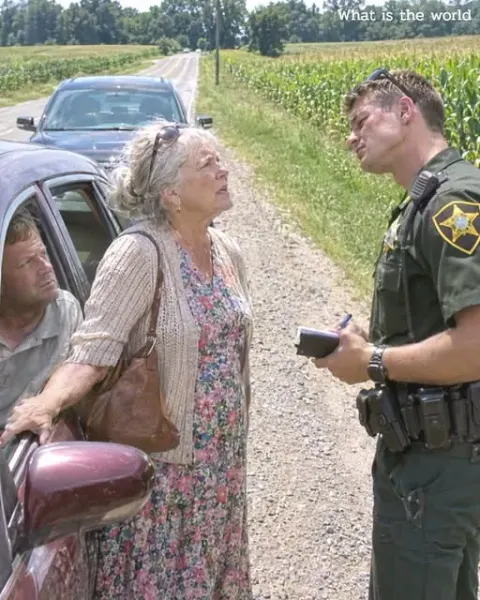
"Have you been paying off student debts, Mrs. Kowalski?"
I didn't lie. I've never been any good at it.
"Yes. For nine years."
"That is a direct violation of district policy," he said, loudly enough for the whole cafeteria to hear. "Staff cannot manipulate student accounts or give away district food. You're done. You're fired. Clean out your locker."
Gloria Banks, my cafeteria manager, gasped behind me. One of the lunch aides, Rosa Delgado, put her hand over her mouth.
I didn't argue. I didn't cry in front of the children.
I just said, "Okay."
I took off my hairnet. I untied my navy apron and hung it on the hook where I'd hung it for twenty-two years. Then I walked around the end of the serving line and knelt down in front of Ciaran, who was crying silently now, tears dripping onto the plastic bag.
"It's okay, sweetheart," I whispered, hugging him. "You'll eat today. I promise."
I slipped my own lunch, a peanut butter and honey sandwich wrapped in wax paper, into the front pocket of his backpack.
Then I walked out to the parking lot, got into my Buick, and cried.
I sat there for two hours. I couldn't make myself turn the key. I kept looking at the building where I'd spent more of my life than anywhere but home, the windows of the cafeteria, the flagpole, the playground behind the chain-link fence.
At one-thirty, the second-grade recess bell rang, and kids poured out onto the blacktop.
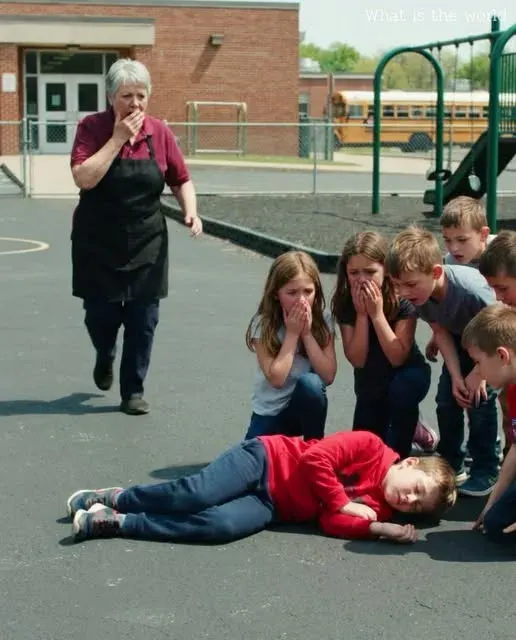
Ten minutes later, I heard screaming.
I looked up. A crowd of children had gathered in a tight circle near the monkey bars around someone lying on the ground.
A small boy.
In a red sweatshirt.
He wasn't moving.
I was out of the car before I knew I'd opened the door. Then I stopped, turned back, yanked open the glove box, and dug under four years of old registrations and napkins until my fingers closed around a small blue tube.
Glucose gel. Walt's. I had never been able to make myself throw it away.
Because I knew something about Ciaran Doyle that I suddenly realized Mr. Quincy should have known too. Ciaran had type 1 diabetes. His mother had told me in September, standing at my serving line with a laminated care plan, asking me please to make sure he always got a full lunch, because the school health aide gave him insulin before lunch based on the carbohydrates on the menu.
He'd been dosed for spaghetti, garlic bread, an apple and chocolate milk.
And he'd been handed a cheese sandwich he was too humiliated to eat.
I ran. Sixty-one years old with bad knees, through the gate and across the blacktop, shouting for the children to move. The recess aide, a young substitute, was crouched beside Ciaran with her phone at her ear, saying, "He just fell down, he just fell down."
His face was gray and sweaty. His lips were pale. His eyes were half open and not seeing anything.
"He's diabetic," I said, dropping to my knees. "His blood sugar's crashing. Where's the nurse?"
"She's at Glenwood on Tuesdays," the aide said, near tears. "The health aide went to lunch."
Behind me, I heard expensive shoes running on the blacktop.
"Step away from that child!" Mr. Quincy shouted. "Mrs. Kowalski, you're no longer an employee! You're trespassing on school property!"
I didn't even look at him.
I twisted the cap off Walt's glucose gel, gently pulled down Ciaran's cheek, and squeezed the sticky gel inside, rubbing it against his gums with my finger the way I had done for my husband on a hundred bad nights.
"Come on, baby. Come on, Ciaran. Mrs. K's here."
One minute. Two. The ambulance siren wailed somewhere down Starr Avenue. Mr. Quincy stood over us, breathing hard, and for once he said nothing.
At three minutes, Ciaran's eyelids fluttered.
At four, he looked at me and whispered, "Mrs. K? I'm hungry."
The children around us broke into ragged cheers, and the substitute aide burst into tears.
The paramedics checked his sugar: forty-one, climbing. They lifted him onto a stretcher. The school health aide came running from the parking lot, white-faced, and told them she had given his full lunch insulin dose at eleven-thirty according to his care plan.
"For the hot lunch," she said. "I always dose him for the hot lunch. Dacey always makes sure he gets it."
Mr. Quincy's face went very still.
Then a battered blue Honda screeched into the bus loop, and a young woman in purple warehouse scrubs jumped out and ran toward the stretcher. Brianna Doyle. Ciaran's mother.
She looked at her son, at the empty glucose tube in my hand, at the paramedic's monitor. Then she turned on Mr. Quincy, because somebody in that crowd had already told her.
"You took his lunch?" she screamed. "You threw away his food? He's diabetic! It's in his file! I handed you that file myself, on the first day of school!"
Mr. Quincy opened his mouth, but nothing came out.
And that's when I saw it, standing two feet from him in the bright October sun. A small, pale, crescent-shaped scar on the left side of his chin.
I had seen that scar before. Twenty-two years ago, on a skinny little boy who split his chin on my serving counter reaching for an extra milk, a boy I sent home every Friday with a grocery bag of food from my own kitchen.
Mr. Quincy looked down at me, and his lips barely moved.
"Mrs. K," he whispered.
Only one child in twenty-two years had ever called me that before Ciaran. And I'd spent two decades wondering what happened to him.