03 / 10
Chapter 3: Helping Him Remember
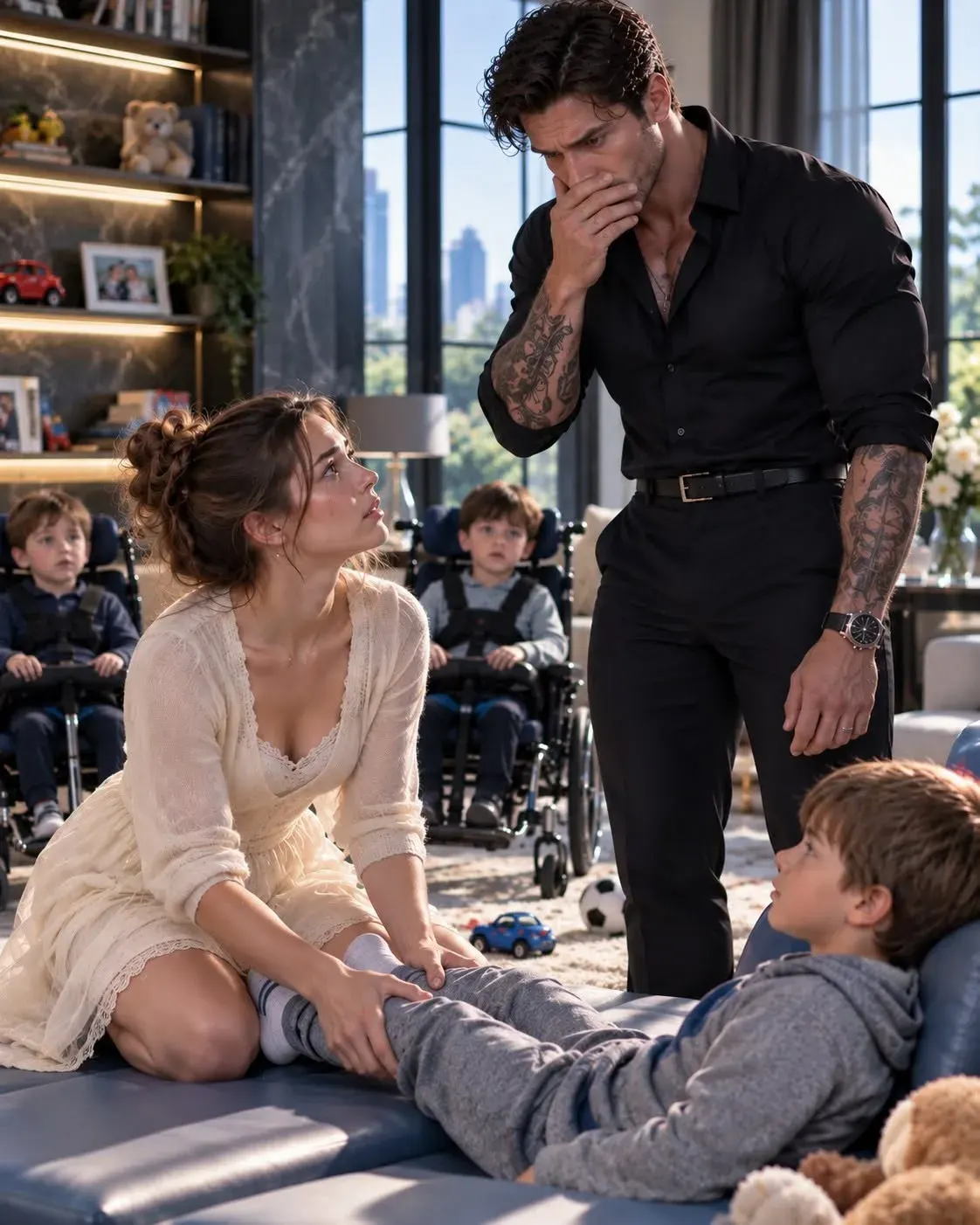
I don't remember the stairs, only my shoes cracking against the marble and Ruth stepping out of the kitchen with a dish towel in her hands. I was still dressed for a meeting I'd skipped that morning—black shirt with the sleeves rolled to the elbows, the old tattoos on my forearms on full display, and the silver watch Nora gave me on our last anniversary.
The therapy room was flooded with soft afternoon light pouring through the floor-to-ceiling windows, across the bare oaks of Lincoln Park and the distant skyline beyond them. Toy cars lay scattered on the plush rug beside a scuffed soccer ball nobody had kicked in two years.
By the time I reached the door, Angela had eased Phillip back onto the cushions beside his teddy bear, and she knelt over him on the blue mat, her hands still guiding his leg forward. Eric and Adam sat quietly in their padded wheelchairs near the window, held upright by their black harnesses, and Adam's eyes followed me as I came into the room.
I stopped right over them, my shadow falling across the mat. "What the hell are you doing?"
She froze, and for three heartbeats the only sound in the room was the soft tick of the radiator. Then she looked up at me with wet eyes that refused to leave mine, her hands still resting on my son's leg as if she had every right in the world to be there.
"Helping him remember," she said quietly.
Something hot and ugly rose in my throat, because I had built my entire life on people doing exactly what I told them, and this woman had been in my house for twenty-one days. I glared down at her, my jaw so tight it ached. "The specialists said he cannot walk."
My voice came out low and flat, which everyone who had ever worked for me knew was worse than shouting.
"Then maybe somebody should stop telling him that," she said, her chin lifting just slightly.
Nobody in the room breathed. Nobody in Chicago talked to me like that—not twice, and usually not once.
"You're not a neurologist," I said, every word measured.
"No," she answered, without looking away.
"You have no authority to change his treatment," I continued, taking one more step forward.
"No," she said again, her voice trembling only a little.
"I gave you one rule," I said, my pulse hammering in my jaw. "So tell me why Leo shouldn't walk you to the gate right now."
She looked down at Phillip, and her thumb moved slowly over his knee, the way you'd calm a frightened animal. When she raised her eyes to mine again, she didn't sound defiant anymore—she sounded almost afraid.
"Yesterday, he moved his leg without me," she whispered.
The anger drained out of me so fast it felt like falling. I didn't decide to do it, but my hand rose and covered my mouth, as if my body understood before my mind did that I couldn't afford to make a sound.
My eyes burned, and I was closer to tears than I had been since the funeral.
"That's impossible," I finally managed through my fingers.
"I knew you'd say that," Angela said. Then she lifted her gaze past my shoulder toward the corner of the ceiling, and my eyes followed hers to the small black security camera staring down at us.
"You recorded it."
None of us moved. Behind me, I heard the faintest sound, a small breathy hum, and when I turned, Adam was looking straight at us.
"Around a quarter past two yesterday," Angela went on. "I had my back to him, and his left knee came all the way up before he pushed his foot back down—twice."
"Why didn't you tell me?" I asked hoarsely.
"Because you would've called it a spasm," she said, swallowing hard. "And I needed you to see it before anyone could explain it away."
I walked out without another word, and when Leo met me at the foot of the stairs asking if I wanted her gone, I told him nobody was to touch her.
Upstairs, I locked my office door and found the file in less than a minute—therapy room, camera three, yesterday's date—and dragged the timeline to two fourteen in the afternoon. Then my finger froze above the button.
For two years, every doctor and every scan had told me the same thing: accept it and stop hoping, because hope would only hurt me more. Every lens in this house existed because I believed people would fail me, and now one of them might prove that the people I'd trusted most had failed my sons.
For the first time in my life, I was afraid to press play.