07 / 10
Chapter 7: Little Red Bird
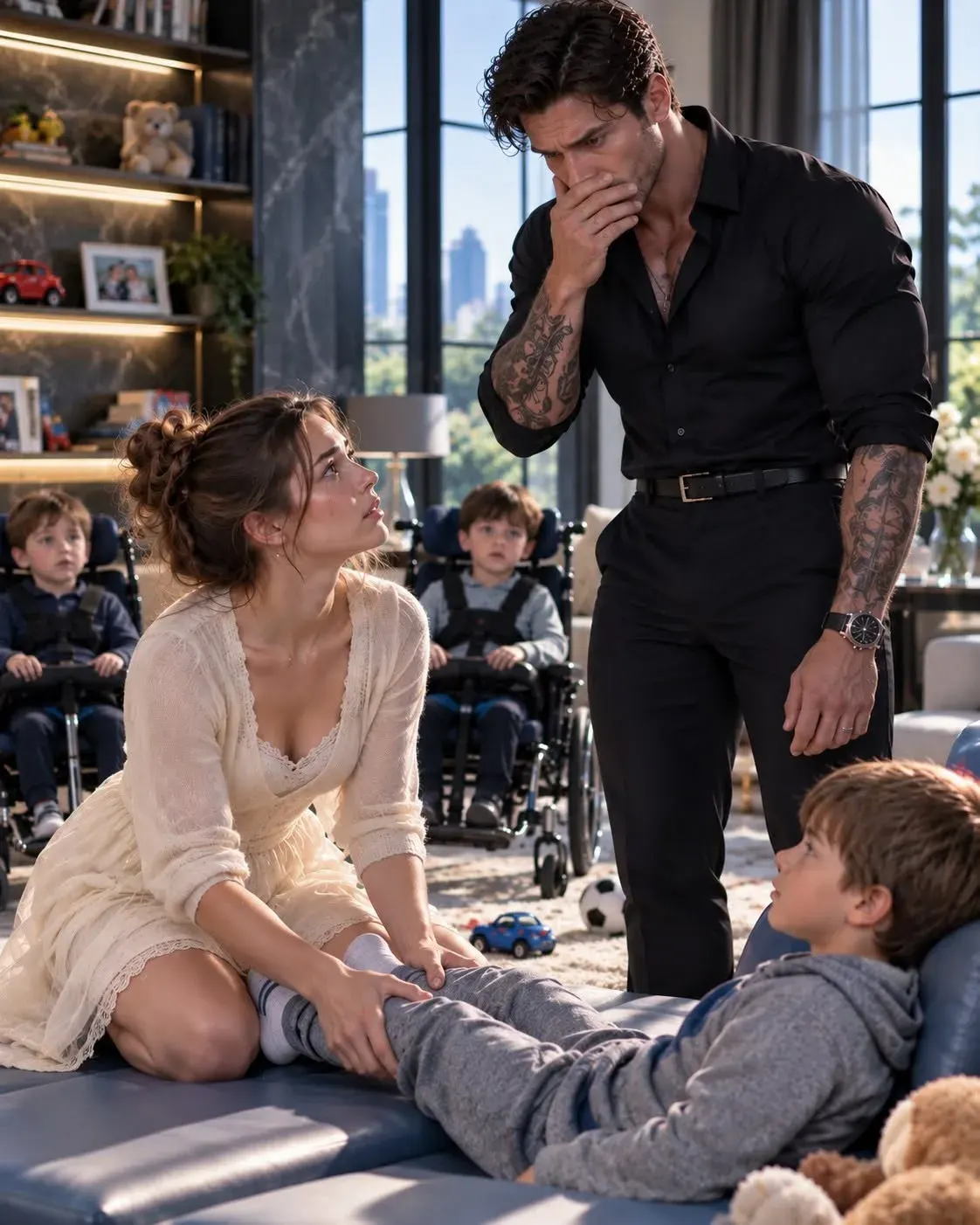
Spring came late to Chicago that year, but it came early to my house. Dr. Lowe and Angela built an entirely new plan together—speech therapy, occupational therapy, sessions in the indoor pool nobody had touched since the accident, and long hours on the blue mats every single day.
For two years, I had stood in doorways, but now I knelt on the floor beside my sons with my sleeves rolled up, my tattooed forearms looking ridiculous next to Angela's careful hands. She taught me how to stretch Eric's tight shoulders without hurting him, how to support Adam's head while he practiced holding it up, and how to press my palm against Phillip's foot and wait—really wait—for him to push back.
"You're rushing him," she told me during the first week, tapping my wrist.
"I'm not rushing anybody," I protested.
"You're breathing like you're rushing him," she said with a small smile. "Kids feel everything, Mr. Grant—slow down."
So I slowed down. The hands that had signed things I would never confess to a priest learned to button a seven-year-old's sweater, and the voice that used to make men sweat learned to do ridiculous pirate accents at bedtime.
And the boys answered.
In April, Eric squeezed my finger when I asked him to, five times out of five, and Ruth cried so hard she had to sit down on the back stairs. In May, Adam followed a toy car with his eyes as Angela rolled it across the mat—and then he followed it with his whole head.
One afternoon, Phillip pushed against my palm so hard that I tipped over backward onto the mat, and Angela laughed until tears streamed down her face. It was the first laugh that room had heard since Nora.
Angela had filled Nora's bird feeder the morning after she arrived, and by May, the cardinals had come back to the yard. Every morning, she wheeled the boys to the tall windows to watch the bright red birds squabble over sunflower seeds, and Adam's eyes followed them every single time.
"Little red birds," Angela told him one morning, resting her chin on the back of his wheelchair. "I promised you they'd come back."
I started coming home at five o'clock, then at four, and eventually I stopped going to most of my meetings at all. Leo handled what he could, and the rest, I simply let go.
There were people in my world who didn't like that one bit. My phone rang late at night with careful questions about my health and my priorities.
I gave every one of them the same answer. My priorities were sitting in three padded wheelchairs on the edge of Lincoln Park, learning how to hold up their heads.
One warm night in late May, after the boys were asleep, I found Angela on the back terrace wrapped in a blanket, gazing out at the glittering skyline. I brought two mugs of Ruth's honey-lemon tea—the same recipe Nora used to drink when she couldn't sleep.
"Can I ask you something?" Angela said, wrapping both hands around the warm mug. "What was she like?"
Nobody had asked me that in two years, because everyone was too afraid to say her name. So I told her about the way Nora laughed with her whole body, her terrible Christmas sweaters, and how she made me slow dance with her in the maternity ward at three in the morning the night the boys were born.
Angela listened to every word, and when I finished, she was smiling. "They have her laugh, you know," she said. "You're going to hear it again someday."
I looked at her in the cool blue glow of the city, the blanket draped around her shoulders and a few loose strands of hair moving in the wind off the lake. Something in my chest that had been frozen since that drawbridge cracked open—just a little.
I didn't say anything, because I wasn't sure I had the right. She worked for me, she had handed my sons back to me, and I was a man whose past still had my phone number.
"Goodnight, Andrew," she said softly, and it was the first time she had ever used my first name.
I stayed out on the terrace long after she went inside, listening to the distant hum of Lake Shore Drive and wondering when I had started counting the hours until morning. For the first time since the funeral, I fell asleep without checking the screens.
At four-thirty the next morning, the alarm on Adam's monitor started screaming.