06 / 10
Chapter 6: The Doctor Who Stopped Looking
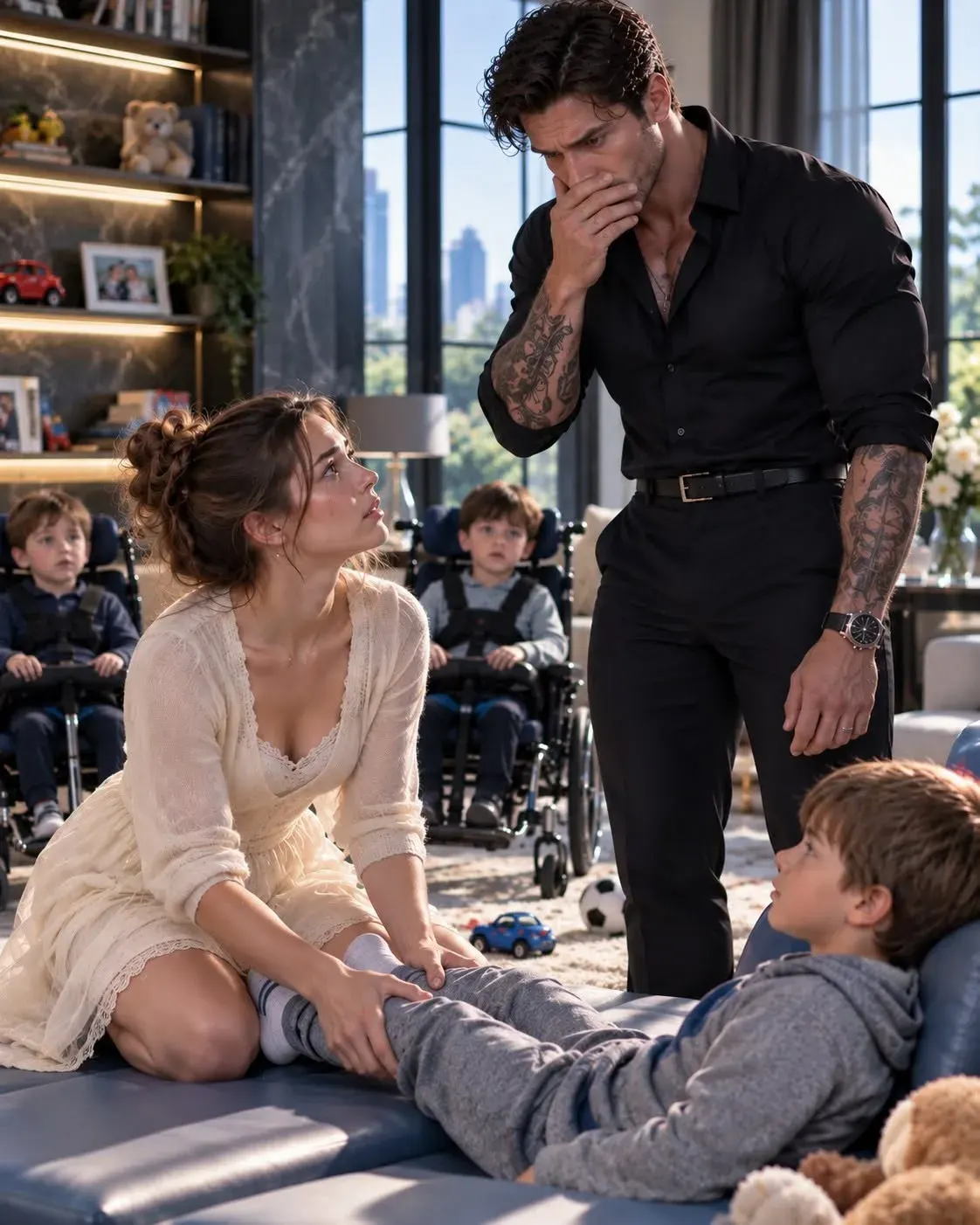
Victor Hale arrived on Friday at ten o'clock sharp, wearing a camel overcoat and the same calm, expensive smile he'd worn for two years. Then he spotted Angela standing by the therapy room window, and the smile slipped—only for a second, but I was watching for it.
"Andrew, I'd prefer to do this privately," he said smoothly. "Staff can be a distraction."
"She stays," I said, and closed the door behind us.
He examined the boys the way he always did, with a penlight in each eye and a sharp tap below each knee. Then he drew the cap of his pen along the sole of each small foot, and I watched Eric's toes curl, Phillip's breathing quicken, and Adam's eyes follow the pen.
"Same as last month—no meaningful change," Hale announced, typing briskly on his tablet. "I'm sorry, Andrew."
"Angela," I said, without taking my eyes off him. "Go ahead."
She knelt on the blue mat beside Phillip and began to sing in that soft, slightly off-key voice. Phillip's head turned toward her, slow and deliberate, while across the room Eric's fingers curled in his lap and Adam opened his eyes again, fixing them on the woman beside his brother.
Then Angela changed the words. "Little red bird," she sang, pressing her palm flat against the sole of Phillip's sock, "can you push my hand?"
His foot pushed back—only an inch, but it was an inch nobody in that room could possibly mistake for anything else.
Hale cleared his throat and adjusted his glasses. "That's a conditioned response," he said dismissively. "I noted similar behaviors in my early reports, and they never progressed."
"You noted them," I repeated. "Then why weren't they in any of the files you gave me?"
The room went completely silent.
I had spent two days with my attorney pulling every page of my sons' records, including the audit history. Their Lakeshore charts had been amended three times, and every note from a junior therapy assistant named Angela Bailey had been deleted.
Hale's private consulting fee came to more each month than most families on the South Side earned in a year—all for a care plan built around keeping my boys comfortable. For two years, I had paid him to keep them exactly where they were.
"You told me it was permanent, Victor," I said. "Then you made sure nobody was ever allowed to look."
"Andrew, you asked me for certainty—" he began, his face going pale.
"I asked you for the truth," I said, low again.
It was the old voice—the one that had ended careers and emptied rooms. I felt that cold, familiar machinery rising inside me, and I knew a dozen ways to make sure a man like Victor Hale never worked in Chicago again, only some of them legal.
Then a gentle hand touched my arm. Angela didn't say anything; she simply looked at me, then at the three boys watching us, and I saw that Adam's eyes were still open, fixed on my face.
I took one slow breath, then another. "Get out of my house, Victor," I said quietly. "My attorneys will be speaking with the state medical board on Monday morning."
He left so fast he forgot his overcoat, and Leo laid it, very neatly, in a snowbank beside his car.
On Monday, a very different doctor came. Dr. Miriam Lowe was a pediatric neurologist from Minneapolis who had spent twenty years working with children everyone else had given up on, and she wore sneakers and sat cross-legged on the therapy room floor for four straight hours.
She watched the footage, read every page of Angela's notebook, and asked Angela to sing. At the end of the day, she found me standing at the tall windows, staring out at the bare trees of Lincoln Park.
"Your sons are not in a vegetative state, and they haven't been for a long time," she said, joining me at the glass. "They're showing clear, consistent signs of awareness, and Phillip's movement is absolutely purposeful."
"Will they walk?" I asked, barely able to get the words out.
"I don't make promises," she said, nodding toward Angela, who was telling Eric a truly terrible knock-knock joke. "But children's brains are stubborn in the best possible way, and somebody has finally been knocking on the right door—if I were you, I'd keep her knocking."
That night, I didn't climb the stairs to my wall of screens. I walked into the therapy room, sat down on the blue mat beside my sons, and asked Angela Bailey to teach me the words to her grandmother's song.
I made it through the first line and stalled on the second, hunting for a note I had already lost.
Before I could find it, a thin, rusty hum rose from the cushions beside me—Phillip, carrying the tune exactly where it belonged.