08 / 10
Chapter 8: I Sent Her Away
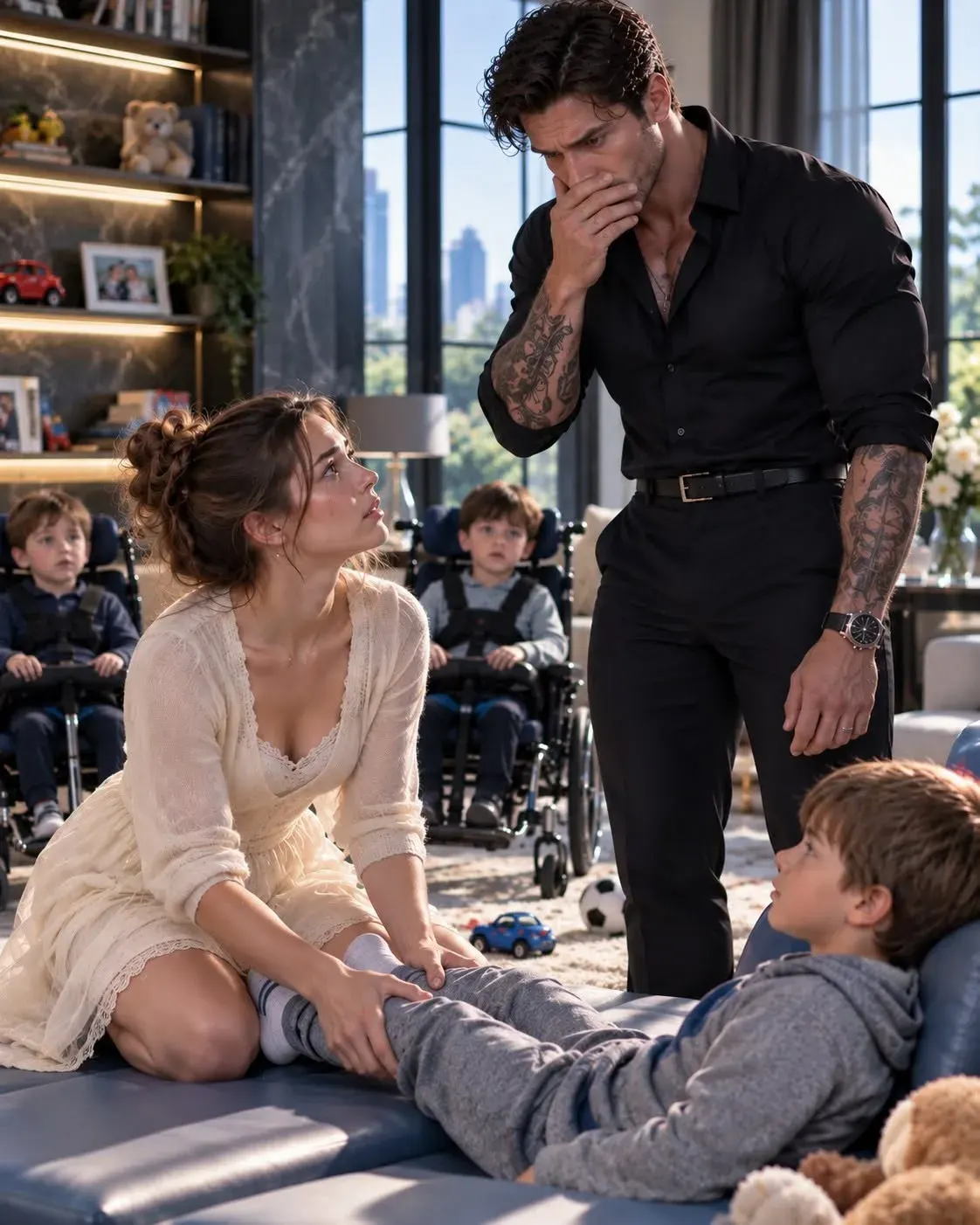
By the time I sprinted downstairs, Angela was already there in a T-shirt and sweatpants, holding Adam upright against her shoulder and listening to his chest. His skin was burning, and his breathing was fast and wet—a terrible rattling sound I had heard once before, in that first winter after the accident.
"It's pneumonia," Angela said, her voice tight but calm. "Call an ambulance—now."
The paramedics arrived in nine minutes, and I counted every single one of them. At the children's hospital downtown, they put Adam in intensive care with an oxygen mask over his small face and wires running to a wall of glowing screens.
I knew how to watch screens—I had been doing it for months. But these screens weren't showing me anything I wanted to see.
By the second day, the doctors had to sedate him and put him on a ventilator, and by the third, they stopped saying when he wakes up and started saying if. I didn't leave his room once.
Somewhere in those long fluorescent nights, the old voice crept back—Hale's voice, my own voice, the one that called me a fool for daring to hope. Every new exercise, every pool session, and every hour on that mat, it whispered, might have pushed him too far.
On the third night, Angela came to the ICU carrying clean clothes for me and a small speaker for Adam's bedside. "Dr. Lowe says familiar sounds might help," she said gently. "I recorded Phillip and Eric laughing, and—"
"Stop," I said, and she stopped.
I stood up slowly. I hadn't slept in sixty hours, and every ugly thing I had ever been was right there under my skin.
"You did this," I said, my voice shaking with exhaustion and fury. "You and your songs and your notebook made me believe, and I pushed him, and now he's lying here because of it."
"Andrew, that's not—" she began, her eyes filling.
"I told you no miracles on your first day," I said, my voice turning to ice. "Hope is a luxury, and my son is the one paying for it."
Her face went white. "I want you out of my house by tomorrow," I said. "Leo will pay you through the end of the year, but don't come back."
For a moment, I thought she would argue, but she didn't. She set the little speaker on the table beside Adam's bed, leaned over him to brush his hair back from his forehead, and kissed it softly.
At the door, she turned back one last time. "Don't let it get quiet in here, Andrew," she whispered. "He needs to hear voices he loves."
Then she was gone, and without her, my house went dark. Ruth called on the fourth day, and I could hear that she had been crying.
"The boys won't open their eyes, Andrew, and Phillip won't turn his head anymore," Ruth said, her voice trembling. "They keep looking for her, or for Adam—I can't tell which."
That night, I sat alone with my son, listening to the machine breathe for him. At three in the morning, a hospital is just as brutally honest as a big house—every beep, every hum, and every mistake you ever made.
And I finally understood the one I had just made. Angela hadn't put my son in this bed—a frozen bridge had, and black ice had, and a meeting I should have skipped had.
She was the only person who had refused to let him stay lost.
I couldn't bring myself to turn on the little speaker, because hearing her voice right then would have broken something I needed to keep whole. So I did the only thing I could think of—I leaned close to my son, took his small, hot hand in mine, and sang.
I have a terrible voice, and Nora used to tease that I sang like a car alarm on Michigan Avenue. But Angela had taught me every word on that blue mat.
Little red bird on the windowsill, the sun is up and the world is still. Open your wings and open your eyes—little red bird, it's time to rise.
My voice cracked on the second line, but I kept going, over and over. On the fourth time through, Adam's fingers closed around mine—weak, barely there, but absolutely real.
On the monitor, his heart rate climbed and then steadied, and a night nurse slipped into the room, glanced at the screens, then looked at me. "Whatever you're doing, Mr. Grant," she whispered, "keep doing it."
So I sang until the sun rose over Lake Michigan. And when it did, I knew exactly where I had to go—men like me don't apologize, and I was going to have to learn fast.